CTO Course: What to Look For (and What to Avoid)
There is a strange gap in the professional development landscape for technology leaders. You can find world-class training programmes for CFOs, CMOs, and COOs. MBA programmes have been refining their curriculum for a century. But when it comes to preparing someone for the CTO role -- arguably the most complex C-suite position, sitting at the intersection of technology, business strategy, people leadership, and operational execution -- the options are surprisingly thin.
The CTO courses that do exist range from genuinely excellent to actively harmful. Some deliver practical frameworks and peer connections that accelerate careers. Others are little more than repackaged management seminars with the word "technology" sprinkled in, sold at premium prices to people who do not yet know enough to tell the difference.
This guide will help you evaluate CTO courses and training programmes with a critical eye -- what to look for, what to avoid, and how to make the most of whatever investment you choose.
What a Good CTO Course Covers
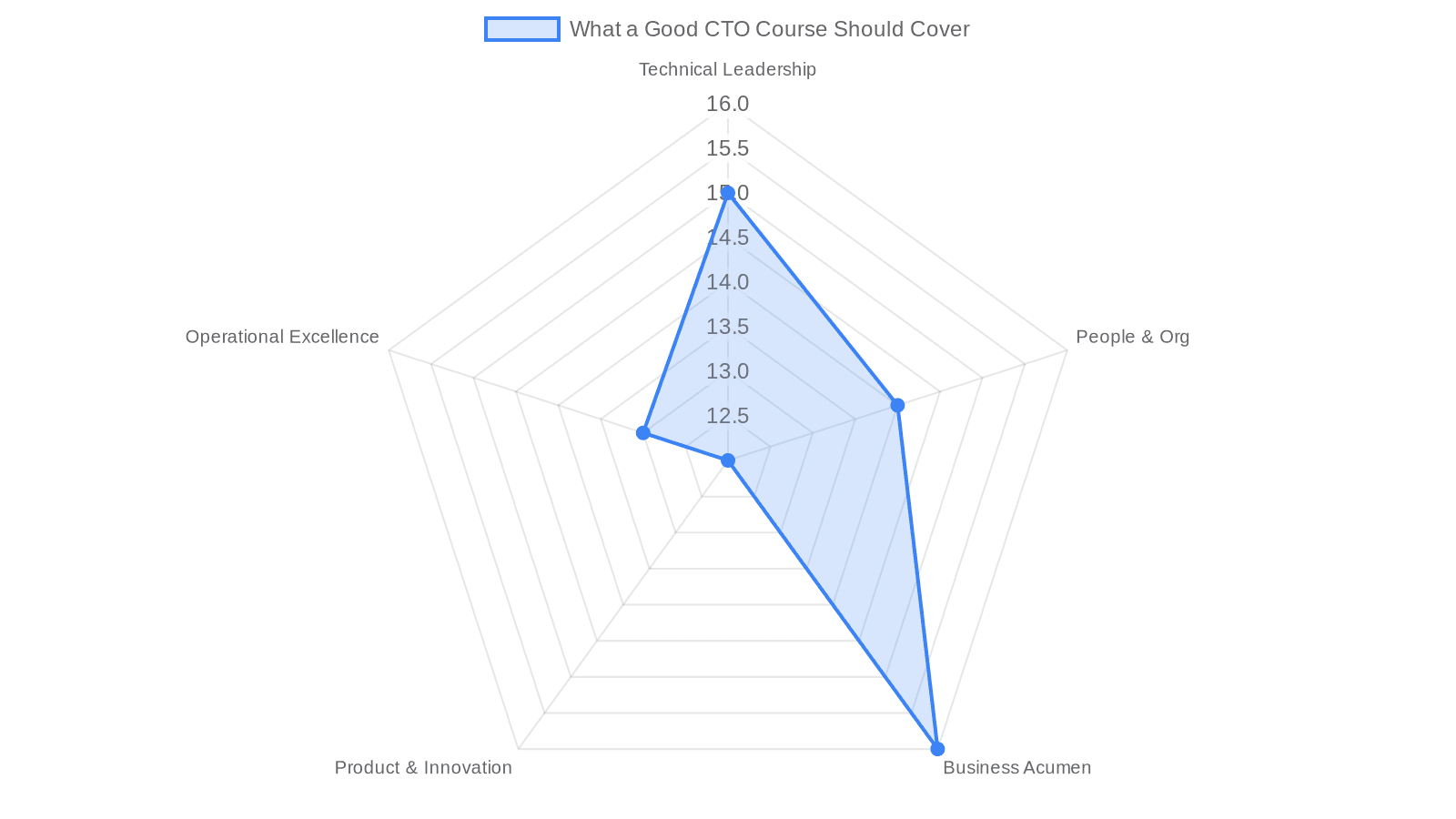
The CTO role spans five distinct dimensions, and any credible training programme should address all of them to some degree. We have written extensively about this in our CTO skills framework, but here is the summary as it relates to evaluating courses.
Technical Leadership
This is not about learning the latest JavaScript framework or getting another cloud certification. Technical leadership at the CTO level means making high-stakes architecture decisions, evaluating build-versus-buy trade-offs, managing technical debt strategically, and maintaining enough technical depth to challenge your team's assumptions without micromanaging their implementation.
A good CTO course covers technical decision-making frameworks, not specific technologies. It teaches you how to think about architecture at scale, how to evaluate emerging technologies without falling for hype, and how to communicate technical strategy to non-technical stakeholders.
Be wary of courses that are essentially advanced engineering curricula dressed up as CTO training. Knowing how to implement a distributed system is valuable, but it is not what makes someone an effective CTO.
People and Organisational Leadership
Most first-time CTOs are former individual contributors or engineering managers who got the title because they were the best engineer in the room. The transition from "best coder" to "leader of the people who code" is one of the hardest professional shifts in technology.
Look for courses that cover hiring and team building at the senior level, organisational design for engineering teams, performance management for technical talent, managing up to a CEO and board, and the emotional intelligence required to lead through uncertainty.
Courses that skip this dimension entirely -- or treat it as a thirty-minute module on "soft skills" -- are missing the area where most new CTOs struggle the most.
Business Acumen
A CTO who cannot read a P&L, understand unit economics, participate meaningfully in fundraising conversations, or translate technology investments into business outcomes is only doing half the job.
Effective CTO training includes financial literacy for technology leaders, strategic planning, stakeholder management, and the ability to frame technology decisions in terms the rest of the leadership team cares about -- revenue impact, risk reduction, time to market, and competitive advantage.
Product and Innovation
The boundary between CTO and CPO varies by company, but every CTO needs to understand product thinking. This means knowing how to align technology roadmaps with product strategy, how to build platforms that enable rapid experimentation, how to evaluate whether a feature request is a genuine business need or an expensive distraction, and how to foster a culture of innovation without destabilising the core product.
Operational Excellence
Shipping software reliably, maintaining security and compliance, managing incidents, planning for scale, and running efficient engineering operations -- these are table-stakes responsibilities that a CTO course should cover. Not at the practitioner level (you presumably already know how CI/CD works), but at the strategic level: how do you build an engineering organisation that operates reliably as it scales from ten to fifty to two hundred people?
Format Matters

The format of a CTO course affects its value at least as much as the curriculum. Here are the main options and their trade-offs.
Self-Paced Online Courses
Strengths: Flexible scheduling, lower cost, ability to revisit material.
Weaknesses: No peer interaction, no accountability, easy to abandon, limited opportunity for personalised feedback.
Self-paced courses work well for filling specific knowledge gaps (financial modelling, security strategy, hiring frameworks) but are generally poor at developing the softer, more contextual skills that CTO work demands. You cannot learn to navigate a difficult board conversation by watching a video about it.
Cohort-Based Programmes
Strengths: Peer learning, structured accountability, networking with other technology leaders, scheduled momentum that reduces dropout rates.
Weaknesses: Fixed schedule may conflict with work demands, quality depends heavily on cohort composition, more expensive than self-paced options.
Cohort-based programmes are often the best value for aspiring or new CTOs. The peer network alone -- a group of people navigating the same challenges at the same career stage -- can be worth more than the course content itself. Some of the most valuable learning happens in unstructured conversations between sessions.
One-on-One Coaching and Mentoring
Strengths: Completely personalised, directly applicable to your current challenges, builds a trusted advisory relationship.
Weaknesses: Most expensive option, quality depends entirely on the coach, limited exposure to peer perspectives.
Coaching is most valuable when you are already in a CTO role and facing specific, high-stakes challenges. It is less effective as a general preparation tool because it lacks the breadth of curriculum and peer exposure that a structured programme provides. The ideal combination for many CTOs is a structured programme for foundational knowledge, supplemented by ongoing coaching for real-time support.
University and Business School Programmes
Strengths: Institutional credibility, rigorous curriculum, strong alumni networks.
Weaknesses: Often expensive, may be overly academic, curriculum may lag behind industry practice, time commitment can be significant.
University programmes vary enormously. Some have built genuinely relevant technology leadership curricula with practitioner instructors. Others have simply bolted a "technology management" label onto an existing MBA module. Check who teaches the programme, how recently the curriculum was updated, and whether the alumni are actually working in CTO roles.
Red Flags in CTO Courses
Watch for these warning signs when evaluating programmes.
Guaranteed outcomes. No course can guarantee you a CTO role, a specific salary increase, or a promotion timeline. Anyone making such promises is selling a fantasy. Career outcomes depend on far too many variables for any programme to guarantee results.
Celebrity instructors who have never been CTOs. There is a cottage industry of "technology leadership coaches" who have impressive social media followings but have never actually held a CTO or equivalent role. Theoretical knowledge has its place, but you want to learn from people who have sat in the chair, made the hard calls, and lived with the consequences.
All theory, no application. If a course is entirely lectures and readings with no case studies, practical exercises, or opportunities to apply concepts to real scenarios, you will retain very little. Adult learning works best when it is grounded in practice.
No peer component. Courses that isolate you in a self-paced content consumption experience are missing one of the most valuable elements of professional development: learning from peers who are facing similar challenges in different contexts.
Outdated curriculum. The technology landscape changes rapidly, and CTO challenges evolve with it. A course whose case studies and frameworks have not been updated in several years may be teaching you to solve yesterday's problems. Check when the content was last revised.
One-size-fits-all approach. A programme aimed at first-time CTOs at seed-stage startups should look very different from one targeting enterprise technology leaders transitioning to the C-suite. If a course claims to be for everyone, it is probably right for no one.
Vague about what you actually learn. If a course cannot articulate its curriculum clearly -- if the sales page is all testimonials and aspirational language but light on specific topics and learning outcomes -- that is a red flag. Good programmes are confident enough in their content to describe it in detail.
Green Flags in CTO Courses

Conversely, here are the indicators that a programme is worth your time and money.
Practitioner instructors. The people teaching have held CTO, VP Engineering, or equivalent roles at real companies. They bring war stories, not just frameworks.
Cohort or community element. The programme creates opportunities for structured peer interaction, not just passive content consumption.
Covers all five dimensions. The curriculum addresses technical leadership, people leadership, business acumen, product thinking, and operational excellence -- not just one or two.
Updated regularly. The programme acknowledges that the technology leadership landscape evolves and updates its content accordingly.
Clear about who it is for. The programme defines its target audience (career stage, company stage, experience level) and tailors its content to that audience.
Practical application. The programme includes case studies, exercises, peer discussions, or projects that require you to apply concepts to real or realistic scenarios.
Transparent about outcomes. The programme shares honest data about participant outcomes, or provides access to alumni you can speak with, rather than relying on cherry-picked testimonials.
Alumni network. Graduates have access to an ongoing community or network. The relationships you build during a programme can be as valuable as the content, but only if there is infrastructure to maintain them.
The Assessment-First Approach
Here is a principle that most CTO courses will not tell you, because it is not in their commercial interest: before investing in any training programme, you should understand exactly where your gaps are.
Too many technology leaders sign up for comprehensive CTO courses and spend significant time and money covering material they already know, while barely touching the areas where they genuinely need development. A twelve-week programme that spends equal time on all five dimensions is only twenty percent efficient if your real gap is in one specific area.
The smarter approach is to assess first, then target your development investment. Take a structured CTO readiness assessment that evaluates you across all the dimensions that matter. Understand where you score well and where you need work. Then choose a course, coach, or programme that specifically addresses your weaknesses.
This does not mean skipping broad programmes entirely. There is real value in a comprehensive curriculum, especially if it includes a strong peer component. But go in knowing what you need to get out of it, so you can focus your attention and energy where they will have the most impact.
Price Versus Value
CTO courses range from free (blog posts, YouTube channels, open-source resources) to tens of thousands of dollars (executive programmes at top business schools). The correlation between price and value is weaker than you might expect.
Some of the most valuable learning happens in free or low-cost formats -- reading deeply about technology leadership, participating in online communities, finding a mentor who has been where you want to go. Meanwhile, some expensive programmes deliver less value than a thoughtful reading list and a monthly dinner with three peers in similar roles.
When evaluating the investment, consider the total cost including your time. A programme that takes two days per week for six months is not just the tuition fee -- it is the opportunity cost of hundreds of hours that could be spent leading your team, building your product, or developing skills through direct experience.
That said, do not default to the cheapest option. The right programme at the right time can compress years of trial-and-error learning into months. Peer networks built during intensive programmes can become career-long assets. And the structured accountability of a paid programme keeps you engaged in ways that free resources rarely do. If budget is a constraint, our guide to free CTO resources curates the best no-cost books, podcasts, communities, and frameworks for technology leaders.
The key is to match the investment to your specific situation. Ask yourself: What is my biggest development gap? What format best addresses that gap? What can I realistically commit to in terms of time and money? And what will the return look like -- not in abstract career advancement, but in my ability to perform in my current or target role?
Conclusion
The CTO role is too complex and consequential to learn entirely on the job. Some form of deliberate development -- whether a formal course, a coaching relationship, a peer group, or a structured self-study programme -- is a smart investment for anyone serious about technology leadership.
But choose carefully. The right programme addresses your specific gaps, teaches through practice rather than theory alone, connects you with peers who sharpen your thinking, and is led by people who have actually done the work.
Start by understanding where you stand. Our CTO readiness assessment takes about fifteen minutes and gives you a clear picture of your strengths and development areas across the five dimensions of CTO capability. Use those results to guide your investment in training -- whether that is a formal course, targeted coaching, or a focused self-study plan.
For a deeper dive into the skills that matter most, read our complete CTO skills framework. And if you are earlier in your journey and still working toward the CTO role, our guide on how to become a CTO maps out the full career path.
Ready to level up?
Discover your strengths and gaps with our free CTO Readiness Assessment.
Take the CTO Readiness Assessment