CTO Readiness Checklist: 25 Questions to Ask Yourself
Before you pursue a CTO role, there is one thing worth doing that most aspiring technology leaders skip: an honest self-assessment.
It is easy to assume you are ready for the top technology job because you have the technical chops, the years of experience, or the title progression on your resume. But the CTO role sits at the intersection of five distinct skill dimensions, and being strong in one or two does not mean you are ready across the board.
This checklist gives you 25 questions, five per dimension, designed to surface your real strengths and the gaps you might be ignoring. Answer them honestly. No one is watching.
If you want a deeper, structured assessment with personalised scoring and recommendations, take the full CTO Readiness Assessment after you finish this checklist.
Why Self-Assessment Matters
The cost of stepping into a CTO role before you are ready is high. For you, it means burnout, imposter syndrome, and a short tenure. For the company, it means stalled technology strategy, engineering attrition, and missed business outcomes. If you do step into the role, having a plan for the first 90 days as CTO dramatically increases your chances of success.
The leaders who succeed in the CTO chair are not necessarily the most technically brilliant. They are the ones who know exactly where they are strong and where they need support, and they build around that self-awareness deliberately.
These 25 questions map to the five dimensions of the CTO Skills Framework. If you have not read that piece yet, it provides the conceptual foundation for why these five areas matter.
The 25 Questions

Dimension 1: Technical Leadership
Technical leadership at the CTO level is not about writing the best code. It is about making sound technology decisions at scale, setting architectural direction, and ensuring your organisation builds the right things in the right way.
1. Can you evaluate a major technology decision (new platform, build vs. buy, architecture migration) without needing to prototype it yourself?
This tests whether you have moved beyond hands-on validation. CTOs need to assess technology choices through a combination of team input, industry knowledge, and strategic reasoning. If you cannot make a confident recommendation without building a proof of concept yourself, you are still operating as a senior engineer.
2. Do you have a clear, defensible technology strategy for the next two to three years, not just a roadmap of features?
A feature roadmap is not a technology strategy. A real technology strategy addresses platform evolution, technical debt management, build-versus-buy decisions, and how technology enables business differentiation. If someone asked you to present your technology vision to a board, could you do it without scrambling?
3. Can you explain your organisation's architecture to a non-technical executive in under five minutes?
This is not about dumbing things down. It is about understanding your systems deeply enough to extract the narrative that matters to the business: what the architecture enables, where the risks are, and what investment is needed.
4. Have you successfully led a major technical migration or platform change that involved coordinating multiple teams?
CTO-level technical leadership means orchestrating large-scale technical change across teams with competing priorities. If your biggest technical achievement was a project you personally executed, you have not yet operated at the scope the CTO role demands.
5. Do you actively track technology trends in your industry and have a point of view on which ones matter?
CTOs are expected to be the company's technology radar. Not chasing every trend, but having a considered perspective on which emerging technologies are relevant to the business and when to invest in them. If your technology awareness is limited to what your team uses today, that is a gap.
Dimension 2: People Leadership
The CTO role is fundamentally a leadership role. You will spend more time on people, organisation design, and culture than on any technical problem.
6. Have you built and led a leadership team (directors, senior managers), not just individual engineers?
Leading engineers is different from leading leaders. At the CTO level, your direct reports are experienced managers and directors with their own teams. If you have only led individual contributors, you have not yet developed the skill of leading through layers.
7. Can you have a difficult conversation (performance issues, role changes, layoffs) without avoiding it or handling it poorly?
Difficult conversations are a weekly occurrence at the CTO level. If you dread them, delay them, or handle them in a way that leaves people confused about where they stand, this is a critical development area.
8. Do your teams consistently ship quality work even when you are not directly involved?
This is the ultimate test of your leadership system. If things slow down or quality drops when you step away, you have built dependency rather than capability. A CTO who is a bottleneck for their organisation is failing at the job, no matter how good their decisions are.
9. Have you hired senior technical leaders who are better than you in their domain?
Insecure leaders hire people they can manage. Strong leaders hire people who make them redundant in specific areas. If you have never recruited someone whose expertise clearly exceeded yours, ask yourself why.
10. Can you design an engineering organisation (team topology, reporting structure, career ladders) for a company two to three times your current size?
CTOs need to think ahead of the organisation. If you can only structure teams based on what you have seen work in the past, you may struggle when the company outgrows your experience. Organisation design is a learnable skill, but you need to have studied it deliberately.
Dimension 3: Business Acumen
This is the dimension where most aspiring CTOs have the biggest gap. You cannot lead technology strategy if you do not understand the business deeply.
11. Can you read a P&L statement and explain how engineering decisions impact each line item?
Financial literacy is not optional for a CTO. You need to understand revenue, gross margin, operating expenses, and how your technology choices affect all of them. If the finance team sends you a report and you skim past the numbers, you are leaving strategic leverage on the table.
12. Do you understand your company's unit economics well enough to explain them to a new engineer?
Unit economics (customer acquisition cost, lifetime value, gross margin per customer) are the foundation of business strategy. If you cannot connect engineering work to these numbers, you cannot make informed trade-off decisions about where to invest engineering effort.
13. Have you been involved in pricing, packaging, or go-to-market decisions for a product you helped build?
Many engineers build products without ever engaging with how those products are sold. CTOs need to understand the commercial side because technology choices directly affect pricing flexibility, packaging options, and speed to market.
14. Can you build and defend a technology budget, including headcount planning, infrastructure costs, and vendor spend?
Budget ownership is a core CTO responsibility. If you have never built a budget from scratch, negotiated for resources with the CFO, or made hard trade-off decisions about where to allocate limited funds, this is a skill you need to develop before stepping into the role.
15. Do you understand how your competitors use technology, and can you articulate where your company's technology is a competitive advantage or disadvantage?
Competitive technology awareness is part of the CTO's strategic toolkit. If you only think about technology in terms of your own codebase, you are missing the broader context that informs technology strategy.
Dimension 4: Communication
Communication is the multiplier that makes everything else work. A CTO who cannot communicate effectively is a CTO who cannot lead effectively.
16. Can you present a technology strategy to a board of directors and handle their questions confidently?
Board communication requires a specific skill: distilling complex technical topics into business-relevant narratives, anticipating non-technical questions, and projecting confidence without arrogance. If you have never presented to a board or executive committee, find ways to practice before you need to do it for real.
17. Can you write a clear, concise document that influences a decision, not just reports information?
CTOs write documents that drive action: strategy memos, investment proposals, incident post-mortems with real accountability. If your writing tends to be either overly technical or vague, this is worth developing. The best CTOs are strong writers.
18. Do you adapt your communication style for different audiences (engineers, executives, customers, investors)?
A single communication style does not work across all of a CTO's stakeholders. The way you explain a technical decision to your engineering team should be fundamentally different from how you explain it to the CEO or a customer. If you default to one mode, people outside engineering will tune you out.
19. Can you publicly represent your company's technology story at conferences, in press interviews, or with partners?
External communication is an increasingly important part of the CTO role. It supports recruiting, partnerships, and brand building. If public speaking or media interaction makes you deeply uncomfortable, invest in developing this skill. You do not need to be a keynote-level speaker, but you need to be competent and confident.
20. When there is a major incident or crisis, can you communicate clearly with all stakeholders without creating panic or confusion?
Crisis communication is a high-stakes test of your communication skills. The CTO needs to keep engineering focused, keep executives informed, and keep customers reassured, all simultaneously and often in real time. If you have been through a major incident and your communication made things worse, learn from it.
Dimension 5: Self-Management
The CTO role is demanding in ways that previous roles do not fully prepare you for. Self-management is what determines whether you thrive or burn out.
21. Do you have a system for managing your time and energy that actually works under sustained pressure?
CTOs face constant context-switching, competing demands, and an inbox that never empties. If you do not have a deliberate system for prioritisation and energy management, the role will consume you. "Working harder" is not a sustainable strategy at the executive level.
22. Can you make high-stakes decisions with incomplete information and live with the ambiguity?
At the CTO level, you will rarely have all the data you want before making a decision. If you tend to over-analyse, delay, or seek consensus as a way to avoid personal accountability for a decision, this is a pattern to address.
23. Do you actively seek feedback from peers, reports, and your manager, and do you act on it?
Self-awareness is a skill, and it requires ongoing input from others. If you have not asked for honest feedback recently, or if you asked but did not change anything based on what you heard, your self-awareness may not be as strong as you think.
24. Can you maintain strategic focus while handling operational demands?
The CTO role constantly pulls you between long-term strategy and immediate operational needs. If you consistently get pulled into firefighting and lose sight of strategic priorities, or if you focus on strategy while operations suffer, you need to develop the ability to hold both.
25. Do you have interests and relationships outside of work that sustain you?
This might seem like a soft question, but it is one of the most important. CTO burnout is real and common. Leaders who have nothing outside of work tend to over-identify with their role, make worse decisions under stress, and burn out faster. Your sustainability as a leader depends on having a life beyond the job.
How to Score Yourself
For each question, give yourself a score:
- 3 points: Yes, I can point to specific evidence and examples.
- 2 points: Partially. I have some experience here but it is not a strength.
- 1 point: Not yet. This is a clear development area.
Add up your scores for each dimension (maximum 15 per dimension, 75 total).
What Your Score Means
Per Dimension
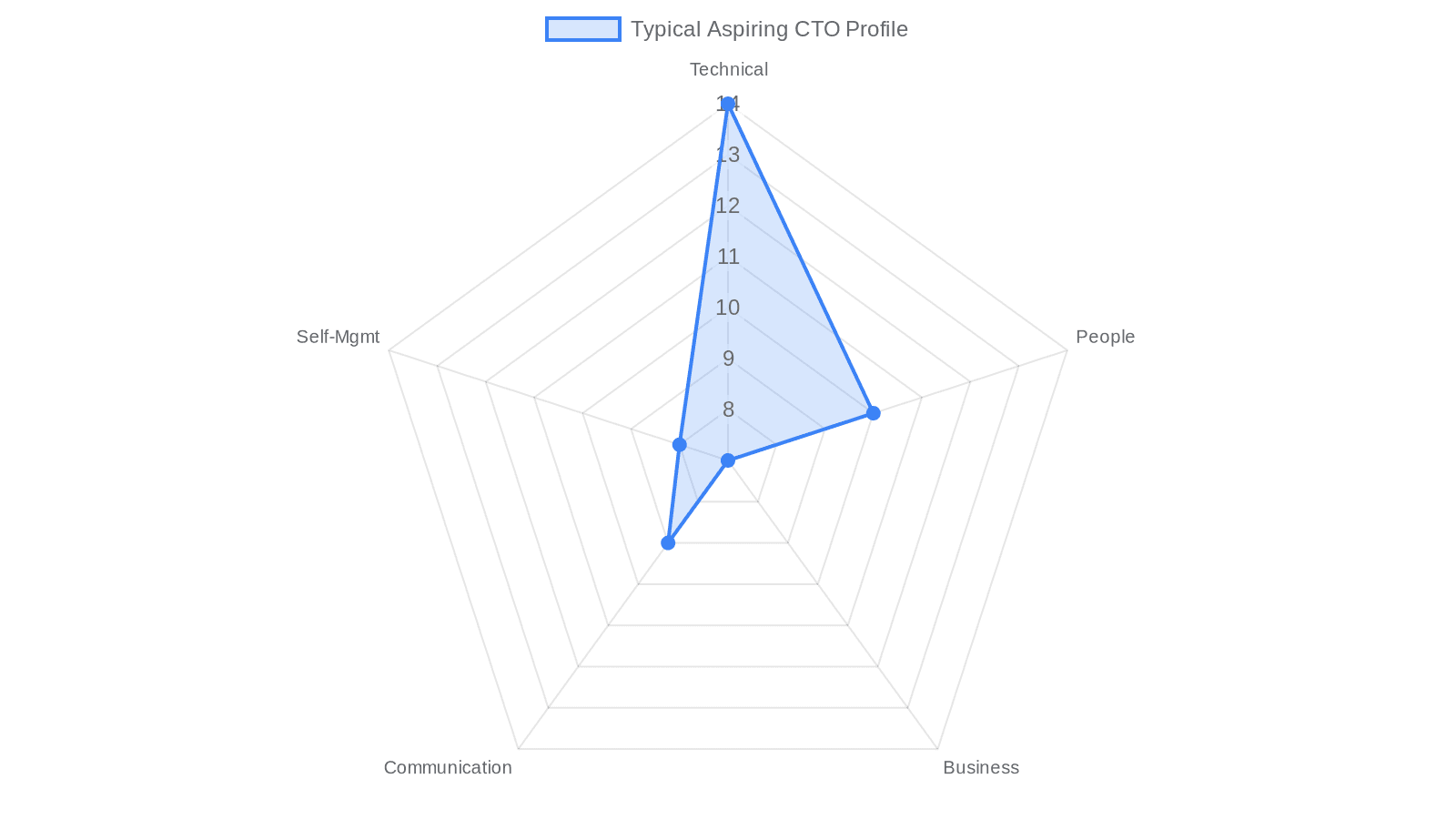
- 13-15: This is a strength. Maintain it and help others develop here.
- 10-12: Solid foundation. Targeted development will close the remaining gaps.
- 7-9: Meaningful gap. This dimension needs deliberate investment before you step into a CTO role.
- Below 7: Significant gap. Consider whether you need more experience at your current level before pursuing the CTO title.
Overall
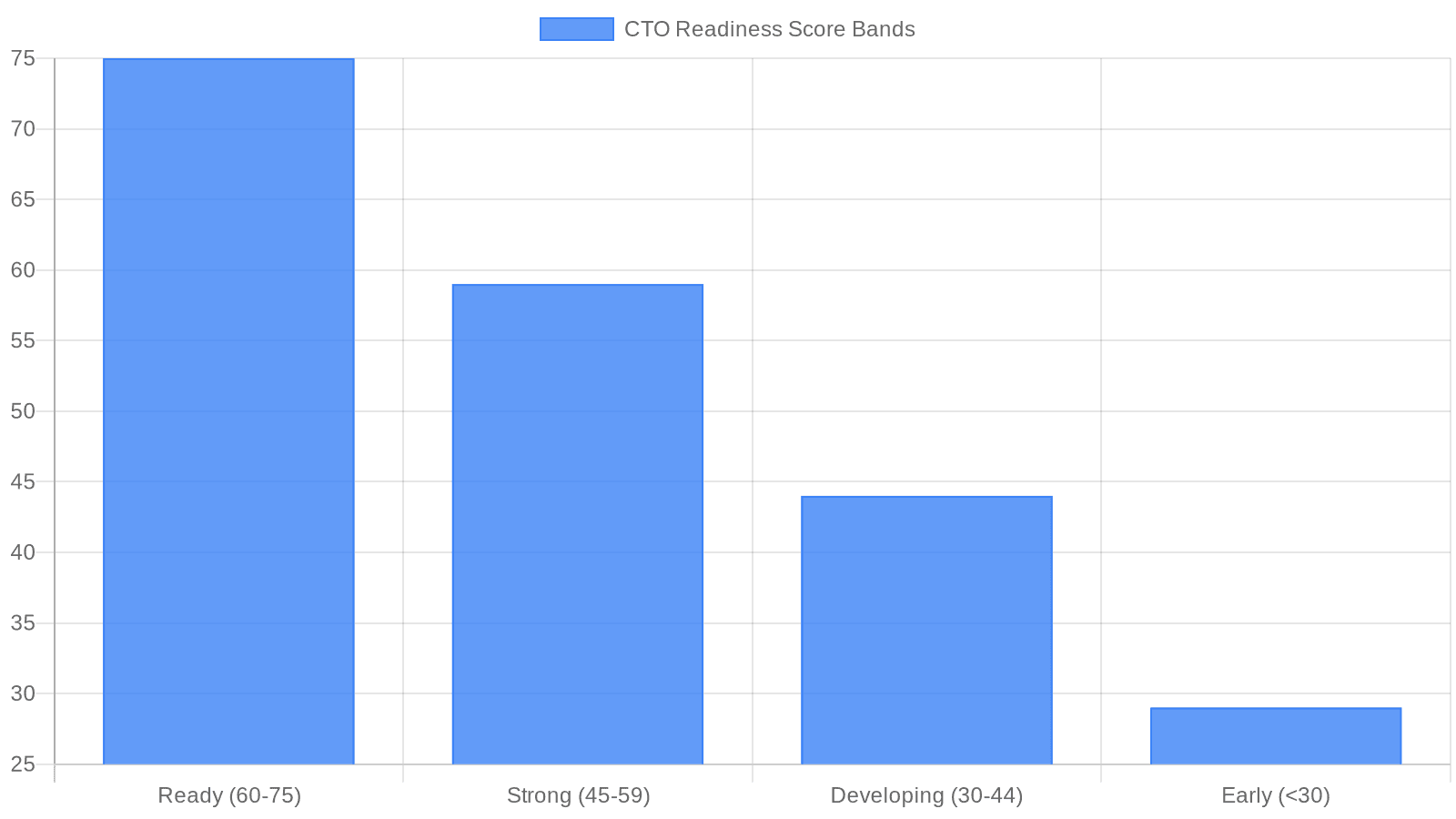
- 60-75: You are likely ready for a CTO role, or close to it. Focus on your weakest dimension.
- 45-59: You have strong foundations but meaningful gaps. Build a 6-12 month development plan targeting your two weakest dimensions.
- 30-44: You are building toward CTO readiness but are not there yet. Focus on getting more scope and experience in your current role.
- Below 30: The CTO role is a longer-term goal. Invest in developing across all five dimensions before targeting it specifically.
The Most Important Pattern
Pay attention to which dimensions score highest and lowest. Most aspiring CTOs score well on Technical Leadership and have their biggest gaps in Business Acumen or Communication. If that is your pattern, you are not unusual, but you do need to address it.
The path to becoming a CTO is not just about accumulating years of experience. It is about deliberately developing across all five dimensions. If you want a detailed breakdown of what that development path looks like, read How to Become a CTO: The Complete Career Roadmap.
Want a Deeper Analysis?
This checklist gives you a useful snapshot, but a 25-question self-assessment has limits. You know your own blind spots least well, and self-scoring tends to be generous in the areas where you are weakest.
The CTO Readiness Assessment provides a structured, comprehensive evaluation across all five dimensions with detailed scoring, personalised recommendations, and a development plan tailored to your specific profile.
If you scored below 60 on this checklist, the full assessment will help you understand exactly where to focus. If you scored above 60, it will validate your readiness and highlight the subtle gaps that could trip you up in your first year.
Take the CTO Readiness Assessment
If you are exploring whether a fractional CTO role might be the right path for you, or if your company needs CTO-level guidance without a full-time hire, Fractional Chiefs connects organisations with experienced fractional technology leaders.
Ready to level up?
Discover your strengths and gaps with our free CTO Readiness Assessment.
Take the CTO Readiness Assessment