What Does a CTO Do? Roles, Responsibilities & Daily Reality
The Chief Technology Officer role is one of the most misunderstood positions in the C-suite. Ask ten people what a CTO does and you will get ten different answers -- from "the best coder in the company" to "the person who picks which cloud provider we use."
The truth is more nuanced. A CTO sits at the intersection of technology, business strategy, and people leadership. The role looks dramatically different depending on company stage, industry, and team size. But there are common threads that define what great CTOs actually do every day.
Whether you are working toward the CTO title or recently stepped into the role, this guide breaks down the real responsibilities, daily reality, and skills that separate effective CTOs from those who struggle.
The CTO Role: A High-Level Overview
At its core, the CTO is responsible for ensuring that a company's technology strategy supports its business goals. That single sentence contains multitudes.
It means the CTO must deeply understand both the technology landscape and the business model. They need to translate between engineering teams who think in systems and architectures, and executives who think in revenue, margins, and market share.
The CTO does not simply choose tools or write code. They create the conditions under which engineering teams can build the right things, at the right pace, with the right quality bar.
Key Responsibilities of a CTO
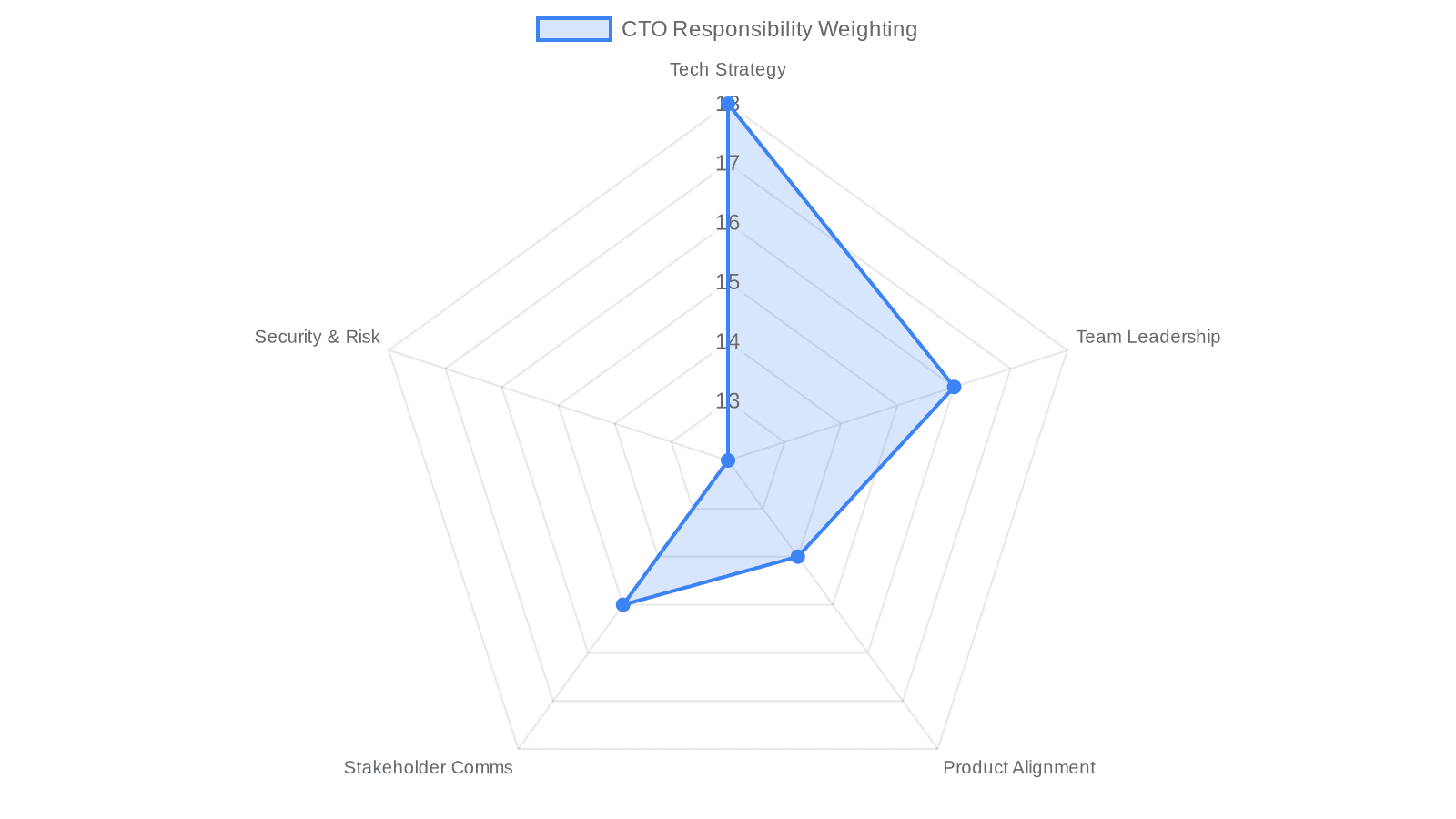
Technology Strategy and Vision
The CTO owns the long-term technology roadmap. This includes decisions about:
- Architecture direction -- monolith vs. microservices, cloud strategy, build vs. buy decisions
- Technology investments -- where to allocate engineering resources for maximum business impact
- Technical debt management -- when to pay it down, when to accept it, and how to communicate trade-offs to non-technical stakeholders
- Innovation pipeline -- evaluating emerging technologies (AI, new frameworks, infrastructure shifts) and deciding what is worth adopting now vs. watching
This is not about chasing trends. The best CTOs make boring, reliable technology choices most of the time -- and bold bets only when the risk-reward profile genuinely favours it.
Engineering Team Leadership
A CTO's impact is measured through the output and health of the engineering organisation, not their personal code commits. Key leadership responsibilities include:
- Hiring and retention -- building a team with the right mix of skills, experience levels, and perspectives
- Engineering culture -- establishing norms around code quality, collaboration, incident response, and continuous improvement
- Organisational design -- structuring teams to minimise dependencies and maximise autonomy (think platform teams, product squads, and enabling teams)
- Career development -- creating growth paths for both individual contributors and engineering managers
- Performance management -- setting clear expectations and having honest conversations when things are not working
At smaller companies, the CTO might directly manage every engineer. At larger organisations, they lead through VPs and directors, setting the vision and guardrails while trusting their leaders to execute.
Product and Business Alignment
One of the most critical -- and most often neglected -- parts of the CTO role is ensuring technology decisions serve business outcomes. This means:
- Partnering with the CEO and CPO to understand market strategy and translate it into technical capabilities
- Prioritisation -- helping the business understand what is technically feasible within a given timeframe, and what trade-offs each option involves
- Revenue enablement -- ensuring the platform can support sales, marketing, and customer success goals (API integrations, performance at scale, reliability targets)
- Cost management -- optimising infrastructure spend, making smart build-vs-buy decisions, and understanding the true cost of engineering time
The CTO who disappears into architecture diagrams and ignores the P&L is not doing the job. Technology exists to serve the business.
Stakeholder Communication
CTOs communicate across every level of the organisation:
- Board and investors -- translating technical progress and risks into language that resonates with non-technical stakeholders
- Executive peers -- collaborating with the CFO on budgets, the CMO on technical marketing capabilities, and the COO on operational systems
- Engineering teams -- providing context on why certain business decisions were made, so engineers understand the "why" behind their work
- Customers and partners -- in many companies, the CTO participates in enterprise sales calls, partner integrations, and customer advisory boards
The ability to communicate clearly to different audiences is arguably the most important skill a CTO can develop.
Security, Compliance, and Risk
The CTO is typically the executive accountable for:
- Information security posture -- from application security to infrastructure hardening to employee security training
- Regulatory compliance -- GDPR, SOC 2, HIPAA, PCI-DSS, and industry-specific requirements
- Disaster recovery and business continuity -- ensuring the company can survive infrastructure failures, security incidents, and data loss scenarios
- Vendor risk management -- evaluating the security and reliability of third-party dependencies
In companies with a dedicated CISO, the CTO partners closely with them. In smaller companies, security falls squarely on the CTO's shoulders.
CTO vs. VP of Engineering vs. CIO

These three roles are frequently confused, and the boundaries between them shift depending on company size and industry. Here is a practical breakdown:
CTO -- Owns the what and why of technology. Focuses on external-facing technology strategy, product architecture, and long-term technical vision. The CTO asks: "What should we build, and how should it be architected?"
VP of Engineering -- Owns the how and when. Focuses on engineering execution, team management, delivery processes, and operational excellence. The VP of Engineering asks: "How do we build it reliably and ship it on time?" For a deeper comparison of these two roles, see CTO vs VP of Engineering.
CIO -- Owns internal technology systems. Focuses on IT infrastructure, enterprise software (ERP, CRM, HR systems), and internal tooling. The CIO asks: "How do we equip the company to operate efficiently?"
In practice, many companies -- especially startups and mid-market businesses -- combine these roles. A startup CTO typically handles all three. As the company grows, the VP of Engineering role often splits off first, followed by the CIO.
Understanding which parts of the role energise you most can help you decide whether CTO is the right target, or whether VP of Engineering might be a better fit. The CTO Readiness Assessment can help you evaluate where your strengths naturally lie.
A Day in the Life of a CTO
There is no "typical" day, but here is what a realistic week might include for a CTO at a growth-stage company:
Monday -- Executive leadership team meeting. Review quarterly OKRs. One-on-one with the VP of Engineering to discuss a struggling team. Review and approve an architecture proposal for a new product feature.
Tuesday -- Deep work morning: review a technical RFC from a staff engineer. Afternoon: customer call with the sales team to discuss an enterprise integration request. End of day: security review of a new vendor.
Wednesday -- Board prep with the CEO and CFO. Draft the technology section of the board deck. Interview a VP of Engineering candidate. Quick Slack check-in with the platform team about a performance issue.
Thursday -- Engineering all-hands presentation on technical strategy for next quarter. Lunch with a peer CTO (networking matters). Afternoon: budget review for cloud infrastructure -- costs are trending up and need investigation.
Friday -- Backlog grooming with product leads. Mentoring session with a senior engineer who is considering the management track. End of day: write a brief internal memo on the company's AI strategy.
Notice what is absent from this list: writing production code. Most CTOs at companies beyond the early startup stage spend very little time coding. Their leverage comes from decisions, communication, and people -- not pull requests.
Different Types of CTOs

The Startup CTO
At a seed or Series A company, the CTO is often a co-founder and the primary (sometimes only) engineer. This CTO:
- Writes code daily, often the majority of the codebase
- Makes all architecture decisions personally
- Hires the first engineers and sets the initial culture
- Wears multiple hats: security, DevOps, QA, and product input
The startup CTO must be comfortable with ambiguity, speed, and doing things that do not scale. The biggest transition challenge comes when the company grows past the point where the CTO can personally review every pull request.
The Enterprise CTO
At a large organisation, the CTO operates as a senior executive with broad strategic responsibility. This CTO:
- Manages through multiple layers of leadership
- Spends most time on strategy, stakeholder management, and organisational design
- Owns budgets in the millions or tens of millions
- Navigates complex compliance and regulatory landscapes
- Balances innovation with operational stability
The enterprise CTO needs strong political skills, patience for process, and the ability to drive change through influence rather than direct authority.
The Fractional CTO
A growing trend, particularly among SMEs and early-stage startups, is the fractional CTO. This is an experienced technology leader who works part-time across multiple companies.
A fractional CTO typically:
- Provides strategic guidance without the full-time cost
- Helps set architecture, hire the first engineers, and establish processes
- Works a set number of hours or days per week
- Is ideal for companies that need senior technical leadership but cannot yet justify a full-time CTO hire
If you are exploring the fractional model -- either as a service provider or as a company looking for fractional leadership -- FractionalChiefs.com connects companies with experienced fractional executives across the C-suite.
Skills That Matter Most
Technical skill alone does not make a great CTO. The role requires a blend of capabilities:
Strategic thinking -- the ability to connect technology decisions to business outcomes, think in timeframes of quarters and years, and anticipate where the market is heading.
Communication -- translating complex technical concepts for non-technical audiences, writing clearly, presenting confidently, and listening actively.
People leadership -- hiring well, developing talent, managing performance, and creating a culture where engineers do their best work.
Architectural judgement -- knowing when to build, when to buy, when to refactor, and when to leave well enough alone. This comes from experience and pattern recognition.
Business acumen -- understanding unit economics, margins, customer acquisition costs, and how technology spend maps to revenue.
Emotional intelligence -- navigating conflict, reading the room in executive meetings, supporting team members through challenges, and maintaining composure under pressure.
Resilience -- the CTO role involves constant context-switching, competing priorities, and accountability for things outside your direct control. The ability to absorb pressure without passing it down to the team is essential.
How to Know If You Are Ready
Becoming a CTO is not just about accumulating years of experience. It is about developing the right combination of technical depth, leadership capability, and business understanding.
Ask yourself:
- Can you articulate how technology strategy connects to revenue and growth?
- Are you comfortable making decisions with incomplete information?
- Do you energise and develop the people around you?
- Can you communicate technical trade-offs to a board or investor audience?
- Have you built and led teams, not just contributed to them?
- Do you understand the security, compliance, and operational aspects of running production systems?
If you are uncertain about where you stand, the CTO Readiness Assessment is designed to give you an honest evaluation across the key competency areas. It takes about ten minutes and provides a personalised breakdown of your strengths and development areas.
The Bottom Line
The CTO role is fundamentally about leverage. Your job is not to be the smartest engineer in the room -- it is to create the environment where the entire engineering organisation can do its best work in service of the business.
That means technology strategy, yes. But it also means people leadership, stakeholder communication, business alignment, and the judgement to know when to push forward and when to hold back.
The best CTOs are not defined by the technologies they chose. They are defined by the teams they built, the decisions they made under uncertainty, and the business outcomes those decisions produced.
If you have just stepped into the role or are about to, our guide to the first 90 days as CTO provides a week-by-week framework for building the foundation of a successful tenure.
Thinking about your path to CTO? Start with our How to Become a CTO guide, or take the CTO Readiness Assessment to benchmark where you stand today.
Ready to level up?
Discover your strengths and gaps with our free CTO Readiness Assessment.
Take the CTO Readiness Assessment