What Is a Fractional CTO? The Complete Guide
Not every company needs a full-time CTO. In fact, for a significant number of startups, scale-ups, and mid-market businesses, hiring a full-time Chief Technology Officer is either premature, unaffordable, or simply unnecessary.
Enter the fractional CTO -- a senior technology executive who works with your company on a part-time or contract basis, providing the strategic leadership you need without the commitment and cost of a permanent C-suite hire.
The fractional model has been gaining traction across the executive suite (fractional CFOs, CMOs, and COOs are increasingly common), but the fractional CTO role is particularly well-suited to today's business landscape. Technology decisions are too important to get wrong, yet many companies cannot justify a six-figure salary plus equity for someone they may only need ten to fifteen hours per week.
This guide covers everything you need to know about fractional CTOs -- what they do, when companies need one, how the engagement works, what it typically costs, and how to decide whether this model is right for your organisation.
What Is a Fractional CTO?
A fractional CTO is an experienced technology executive who serves as your company's Chief Technology Officer on a part-time, contract, or retainer basis. They bring the same strategic capability as a full-time CTO -- technology vision, architecture oversight, team leadership, vendor evaluation, and board-level communication -- but they divide their time across multiple clients rather than dedicating themselves to a single organisation.
The "fractional" label is important. This is not a consultant who parachutes in, writes a report, and disappears. A fractional CTO embeds themselves in your business. They attend leadership meetings, work directly with your engineering team, and take ownership of technology outcomes. The difference is simply the number of hours per week and the nature of the contractual relationship.
Most fractional CTOs are experienced operators who have held full-time CTO or VP Engineering roles at one or more companies. They have built teams, shipped products, navigated technical crises, and learned hard lessons about what works and what does not. That depth of experience is precisely what makes the fractional model valuable -- you are getting battle-tested leadership without having to pay for it forty hours a week.
What Does a Fractional CTO Do?
The specific responsibilities vary depending on the company's stage, needs, and existing team. But fractional CTOs typically cover four key areas.
Technology Strategy and Architecture
This is the foundation. A fractional CTO evaluates your current technology stack, identifies risks and opportunities, and develops a forward-looking technology roadmap aligned with your business goals. This includes:
- Architecture decisions -- cloud infrastructure, monolith vs. microservices, build vs. buy trade-offs, and platform scalability planning
- Technical debt assessment -- understanding where shortcuts have been taken and creating a realistic plan to address them without derailing product delivery
- Technology selection -- evaluating frameworks, tools, and platforms objectively, without the biases that come from "we have always done it this way"
- Security and compliance posture -- ensuring the technology stack meets regulatory requirements and follows security best practices
For many companies, this strategic layer is exactly what has been missing. The team can build things, but nobody is ensuring they are building the right things in the right way.
Engineering Team Building and Leadership
A fractional CTO does not just set strategy -- they help you execute it through people. This means:
- Hiring -- defining role requirements, reviewing candidates, and conducting technical interviews for senior hires
- Team structure -- designing an engineering organisation that can scale, with clear roles, career paths, and reporting lines
- Process improvement -- introducing or refining development practices (code review, CI/CD, incident response, sprint planning) without over-engineering the process
- Mentoring senior engineers -- helping your technical leads grow into the leaders your company needs as it scales
- Performance assessment -- providing honest, experienced evaluation of team capabilities and gaps
If you already have a strong engineering team but lack senior technical leadership, a fractional CTO can be the missing layer that unlocks their potential.
Due Diligence and Investor Relations
For companies that are raising capital or going through M&A activity, a fractional CTO provides critical support:
- Technical due diligence preparation -- ensuring your codebase, architecture, and team can withstand investor scrutiny
- Board reporting -- translating technical progress, risks, and resource needs into language that resonates with non-technical investors
- Post-funding execution planning -- turning a funding-driven growth plan into a concrete engineering hiring and delivery roadmap
Investors increasingly expect companies to have credible technical leadership. A fractional CTO satisfies that requirement while demonstrating capital discipline -- you are investing in the right level of leadership for your current stage.
Vendor Selection and Management
Technology vendor decisions can lock a company into multi-year commitments. A fractional CTO brings independent perspective to:
- Platform evaluations -- CRM, ERP, payment processing, cloud providers, and development tools
- Contract negotiation -- understanding what is negotiable, what pricing is reasonable, and where vendor lock-in risks lurk
- Agency and outsourcing oversight -- if you rely on external development teams, a fractional CTO ensures quality, manages the relationship, and protects your interests
This is especially valuable for non-technical founders who may not have the background to evaluate vendor claims critically.
When Do Companies Need a Fractional CTO?

The fractional CTO model fits several common scenarios.
Pre-Product Startups
You have a business idea and possibly initial funding, but no product yet. You need someone to define the technical architecture, help you decide whether to build in-house or outsource, hire your first engineers, and ensure you do not make expensive early mistakes that compound as you scale.
A full-time CTO at this stage is often impractical -- the company may not have the revenue or funding to justify the salary, and the workload may not warrant forty hours per week of executive attention.
Post-Funding Scale-Ups
You have raised a round, the product has traction, and now you need to scale -- the team, the infrastructure, and the processes. A fractional CTO can guide this transition, implementing the engineering practices and organisational structures needed to grow from a scrappy team of five to a structured team of twenty-five.
Bridge to a Full-Time Hire
Hiring a great full-time CTO takes time -- typically three to six months for the right person. A fractional CTO can hold the fort during the search, ensuring technology leadership does not lapse. Better still, they can help define the role, participate in the hiring process, and ensure a smooth handover.
Non-Technical Founding Teams
If no founder has a deep technology background, a fractional CTO fills a critical gap. They can be the technical voice in the room when strategic decisions are being made, preventing the common pattern where technology is treated as an afterthought until something breaks.
Companies in Technical Crisis
Legacy systems failing, security breaches, a critical engineer leaving, or a product that cannot scale -- these situations need experienced leadership quickly. A fractional CTO can stabilise the situation, develop a recovery plan, and guide execution while the company decides on its longer-term leadership structure.
Fractional CTO vs. Full-Time CTO
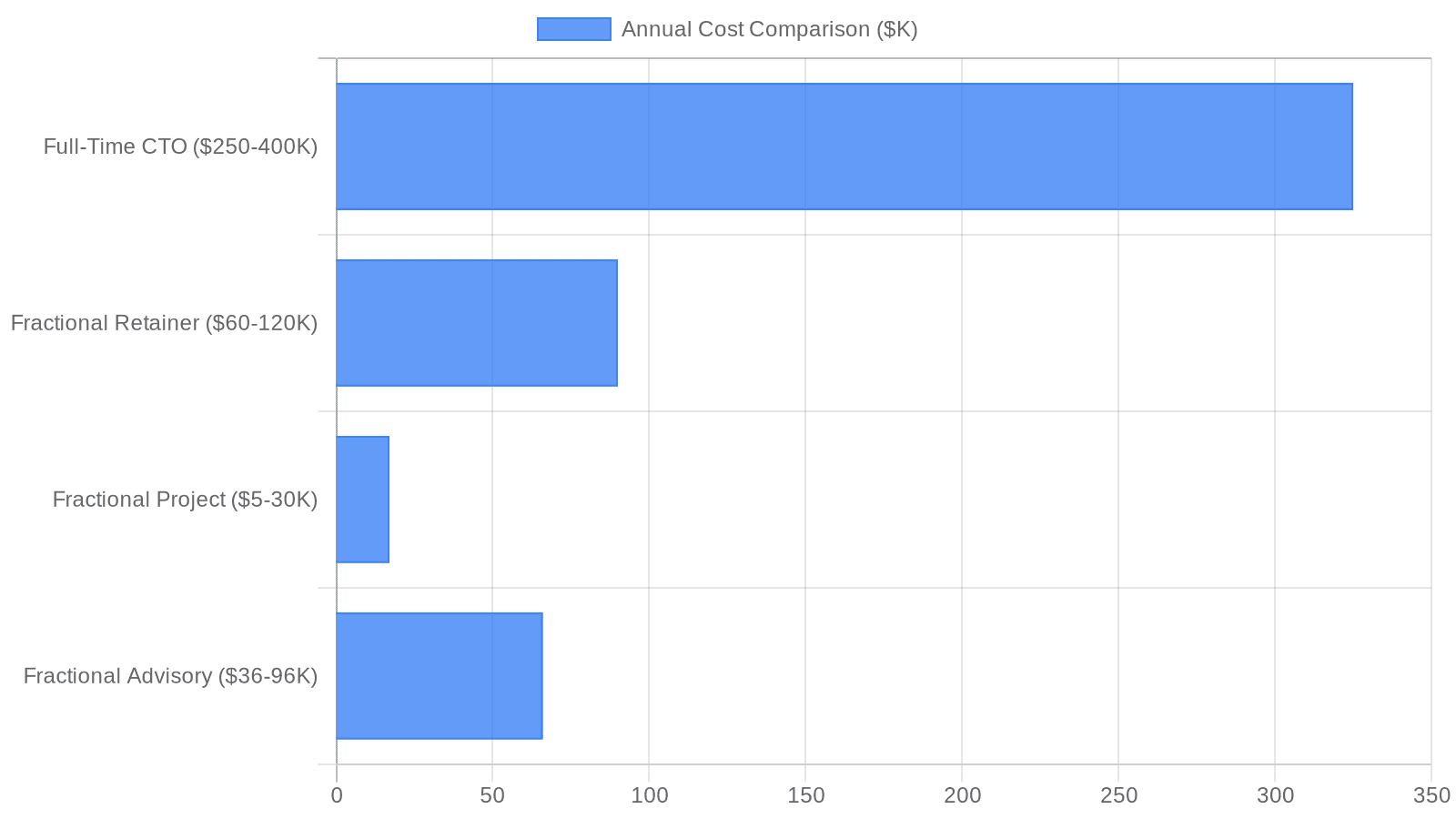
The choice between fractional and full-time is not about which is better in the abstract. It depends on your company's stage, budget, and needs.
A full-time CTO makes sense when:
- Technology is your core product or primary competitive advantage
- You have a large engineering team (typically twenty-plus) that needs daily leadership
- The complexity and pace of technical decisions require someone fully embedded every day
- You can afford the total cost of a senior executive hire (salary, equity, benefits)
A fractional CTO makes sense when:
- You need strategic technology leadership but not forty hours per week of it
- Your budget does not support a full-time C-suite technology hire
- You are in a transitional period (pre-product, between CTOs, or post-funding)
- You have a capable engineering team that can execute day-to-day but needs senior guidance and oversight
- You want experienced perspective without the long-term commitment of a permanent hire
Many companies start with a fractional CTO and transition to full-time as they grow. The fractional CTO can even help define what the full-time role should look like and assist in the hiring process.
Typical Engagement Models

Fractional CTO engagements generally fall into three models.
Retainer (Most Common)
A fixed number of hours per week or month, typically ranging from eight to twenty hours per week. The fractional CTO attends regular leadership meetings, is available for ad-hoc decisions, and works on defined strategic priorities. This provides continuity and embeddedness while keeping costs predictable.
Project-Based
A defined scope of work with clear deliverables -- for example, a technology audit, a due diligence preparation, a migration plan, or an architecture redesign. The engagement has a start and end date, and pricing is based on the project scope rather than ongoing hours.
Advisory
A lighter-touch arrangement, typically a few hours per month, focused on strategic counsel rather than hands-on work. The fractional CTO serves as a sounding board for the CEO or founding team, providing guidance on major decisions without getting involved in day-to-day execution. This works best for companies that have competent technical teams but want experienced oversight.
Most fractional CTOs are flexible about structuring engagements to match each client's needs. The key is being clear about expectations, deliverables, and availability from the outset.
What to Expect Cost-Wise
Fractional CTO pricing varies significantly based on experience, engagement model, and geography. As a general guide:
- Retainer engagements typically range from a few thousand to mid-five figures per month, depending on hours and the seniority of the individual
- Project-based work is priced according to scope and complexity
- Advisory arrangements are usually the most affordable, reflecting the lighter time commitment
For comparison, a full-time CTO at a funded startup in a major market typically commands a base salary well into six figures, plus equity, benefits, and bonus potential. The total cost of a full-time hire is typically three to five times the cost of a fractional engagement -- often more when you factor in equity dilution.
The value proposition is straightforward: you get access to the same calibre of leadership for a fraction of the cost, paying only for the time you actually need. For detailed rate breakdowns and compensation benchmarks, see our fractional CTO salary and rates guide.
How to Find a Fractional CTO
Finding the right fractional CTO requires the same rigour you would apply to any senior hire. Look for:
- Relevant experience -- have they operated at the stage and scale your company is at? Have they worked in your industry or with similar technology stacks?
- Proven leadership track record -- not just technical skill, but demonstrated ability to build teams, communicate with non-technical stakeholders, and drive business outcomes through technology
- Cultural fit -- a fractional CTO needs to integrate with your leadership team quickly, which requires strong interpersonal skills and adaptability
- References -- talk to previous clients and colleagues, not just the candidates themselves
One effective approach is working with a platform that specialises in matching companies with vetted fractional executives. Fractional Chiefs connects businesses with experienced fractional CTOs (as well as CFOs, CMOs, and other C-suite roles) who have been vetted for both technical depth and executive capability. Rather than searching blindly on LinkedIn or relying on word of mouth, a specialised matching service can significantly reduce the time to find the right fit and the risk of a poor match.
Whatever route you choose, invest the time upfront to ensure alignment on expectations, communication cadence, and success metrics. The best fractional CTO relationships are built on clarity and trust.
Is the Fractional CTO Path Right for You?
If you are an experienced technical leader considering the fractional route yourself, it is worth understanding what the role demands.
Fractional CTOs need the full range of CTO skills -- technical depth, business acumen, communication, and leadership -- but they also need the ability to context-switch between multiple companies, build trust quickly, and deliver impact in compressed timeframes. You do not have the luxury of a ninety-day ramp-up when a client is paying by the hour.
The rewards are significant: variety, autonomy, the ability to work with multiple interesting companies, and often better economics than a single full-time role. But it requires discipline, strong personal organisation, and comfort with ambiguity.
If you are curious about whether your skills and experience align with CTO-level leadership -- whether full-time or fractional -- take the CTO Readiness Assessment. It evaluates your capabilities across the key dimensions that matter for the role and highlights areas for development.
You can also explore what a CTO actually does day to day to ensure your expectations match the reality of the role.
Conclusion
A fractional CTO gives growing companies access to senior technology leadership without the cost, commitment, and risk of a full-time executive hire. For startups, scale-ups, and mid-market businesses navigating critical technology decisions, the fractional model offers a pragmatic path to getting the strategic guidance they need at a price point that makes sense.
The model works because great technology leadership is about judgment, experience, and decision-making quality -- not about the number of hours someone sits in your office. A fractional CTO who spends ten focused hours per week on your business can deliver more strategic value than a mediocre full-time hire who is present forty hours but lacks the experience to make the right calls.
Whether you are a founder looking for your first technology leader, a company bridging between full-time CTOs, or a technical leader considering the fractional path yourself, the key is matching the leadership model to the company's actual needs and stage.
If you are exploring whether a fractional CTO is right for your company, Fractional Chiefs can help you find the right match. And if you are evaluating your own readiness for this kind of leadership role, start with the CTO Readiness Assessment.
Ready to level up?
Discover your strengths and gaps with our free CTO Readiness Assessment.
Take the CTO Readiness Assessment