Board-Ready CTO Communication: Presenting Engineering to Non-Technical Leadership
You built your career on being right about hard technical problems. Then you made CTO, walked into your first board meeting, and discovered that being right is not the job any more. Explaining it is.
Nobody warns you about this. In our State of First-Time CTOs 2026 analysis, the single most consistent gap among CTOs promoted from senior-engineering roles was not technical — it was commercial vocabulary. The ability to take an engineering reality and translate it into the language of risk, money, and confidence that a board actually acts on. It is the most expensive skill to be missing in your first year, and the one your entire background did the least to prepare you for.
This guide is about closing that gap: what the board actually wants from you, how to translate engineering into their language, and how to structure an update so a room full of non-technical people leaves trusting you more than when you walked in.
What the board actually cares about
Start by throwing out the assumption that the board wants to understand your systems. They do not. They want to understand three things, and everything you say should map to one of them:
- Are we going to hit the plan? Will technology deliver what the business is counting on, on the timeline the business is counting on?
- What could kill us? What are the risks — security, scaling, key-person, technical-debt — big enough to threaten the company, and what are you doing about them?
- Are we spending wisely, and do we have the team? Is the money going to the right places, and can the org you have actually execute the plan?
That is the whole frame. A board member does not care that you migrated to a new message queue. They care whether that migration made the company more or less likely to hit the plan, more or less exposed to a risk, and whether it was a good use of the money. If you can answer those three questions clearly, you can walk into any board meeting. If you cannot, no amount of architecture detail will save you.
Translate engineering into board language
The core skill is translation. Every important thing happening in your org has an engineering framing (true, precise, and meaningless to the board) and a business framing (also true, and the only version that lands). Your job is to speak the second one.
| What you'd say to an engineer | What the board needs to hear |
|---|---|
| "Our test coverage is around 40%." | "Here's our current risk of a costly outage, and the specific plan to bring it down over the next two quarters." |
| "We're paying down technical debt." | "We're clearing the specific blockers standing between us and the next two revenue initiatives." |
| "The platform migration is 60% done." | "We're on track to cut our release time roughly in half by Q3, which is what lets sales promise faster delivery." |
| "We need two more senior engineers." | "Here's what we can confidently ship with the team we have — and here's the specific thing a senior hire unlocks that we otherwise can't." |
Notice the pattern. The board version always answers so what? It connects the engineering fact to a business consequence the board already cares about — revenue, speed, risk, cost. If a line in your update does not connect to one of those, cut it. It is detail, and detail is what you offer if they ask, not what you lead with.
This is also how you handle the hardest recurring conversation of your first year: the tension between shipping features and paying down debt. The board wants velocity; the codebase needs investment. Framing debt paydown as "fixing the codebase" invites a board to wonder why you are polishing the plumbing instead of building. Framing it as "unblocking the next two strategic initiatives" — with named initiatives — turns the same work into something the board can validate. Same work. Completely different reception.
Structure the update so it lands
Non-technical audiences do not follow a build-up to a conclusion. They need the conclusion first, then the support. Structure every update as an inverted pyramid: the answer at the top, the few things that matter in the middle, and the detail waiting underneath for anyone who wants it.
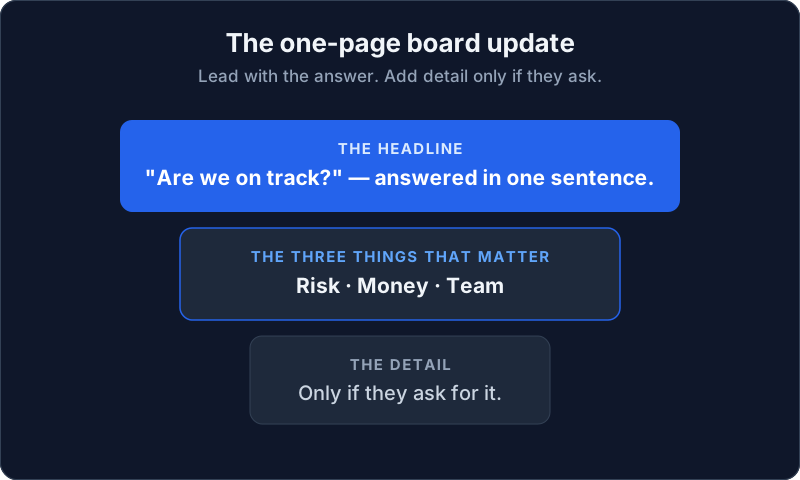
The headline. One sentence, up top, answering the only question the board arrived with: are we on track? "Engineering is on plan for the Q3 launch, with one risk I'm actively managing." That sentence does more work than the next ten slides. It tells the board how much to worry before they have read anything else.
The three things that matter. Under the headline, three short items — no more — covering risk, money, and team. A risk you are managing. A spend decision or a resourcing constraint. A signal about the health or capacity of the org. Three is not a limit you will struggle to reach; it is a discipline that forces you to decide what actually matters this quarter.
The detail, on request. Everything else — the architecture, the metrics, the migration status — lives in an appendix or in your head, ready if a board member pulls the thread. Offering to go deeper ("happy to walk through the security work in detail if useful") signals command without drowning the room. You are not hiding the detail. You are respecting that most of the room does not need it.
Keep the whole thing to one page. A one-page update that the board reads and remembers beats a twenty-slide deck they endure and forget.
Handle the hard moments well
Board credibility is built less in the good quarters than in how you deliver bad news. A few patterns that separate CTOs the board trusts from ones they start to manage:
Bring bad news early, with a plan attached. A risk you surface yourself, three months out, with a plan, reads as control. The same risk discovered by the board first, or surfaced as a surprise, reads as a CTO who is not on top of their org. Never let the board find a problem before you have named it. The rule is simple: no surprises.
Never answer "why is this taking so long" with an engineering excuse. The honest engineering answer — the estimate was optimistic, an integration was harder than expected, someone left — is true and it will erode you. The board answer names the new date, the reason in business terms, and what you have changed so the next estimate is more reliable. Own the miss, then move to the fix.
Keep a scoreboard. The difference between "the new CTO is rebuilding everything" (board panic) and "the new CTO cut four weeks off our release cycle last quarter" (board confidence) is often just a visible record of what shipped, what got faster, and what stopped breaking. A one-page monthly scoreboard, kept consistently, does more for your standing than any single brilliant meeting.
When you don't know, say so — then say when you will. "I don't have a confident number on that yet; I'll have one to you by Friday" is a stronger answer than a made-up figure the board later catches. Precision about your own uncertainty is a credibility signal, not a weakness.
Before, during, and after the meeting
The meeting itself is the smallest part of the work.
Before. Pre-wire anything sensitive. If there is a hard message — a slip, a risk, a spend request — the board should not hear it first in the room. A short conversation with the CEO, and often the relevant board member, before the meeting means the meeting confirms a direction rather than reacting to a surprise. Boards hate being surprised in front of each other more than they hate bad news.
During. Lead with the headline, watch the room, and follow the questions rather than your slides. If they are engaged on one risk, stay there — that is the conversation they came to have. Resist the pull to cover everything you prepared. A board update is a discussion you are steering, not a presentation you are delivering.
After. Send a short written follow-up: the decisions made, the things you committed to, and the dates. It closes the loop, creates a record, and quietly reinforces that you are someone who does what they said they would. It is also where you build the next quarter's credibility, one kept commitment at a time.
Where to go from here
Board communication is learnable, but it is a genuinely different skill from the one that got you promoted — and it is the one first-time CTOs most often try to learn alone, under pressure, in the highest-stakes room in the company. That is exactly the kind of gap a good coach compresses. If you want an outside sounding board who has sat on the other side of that table, our curated directory of CTO coaches groups specialists by how they work and who they are best for, including several with an explicit board- and stakeholder-communication focus.
If you would rather map your own strengths and gaps first — communication is one of five dimensions we measure — start with the free CTO Readiness Assessment. And for the wider picture of what the first-time CTO role actually demands, the first-time CTO guide is the place to begin.
The board is not testing whether you are a good engineer. They already believe that; it is why you have the seat. They are testing whether you can carry the technology story into the room where the company's biggest decisions get made — clearly, honestly, and in their language. Get that right, and the rest of the role gets easier.
Ready to level up?
Discover your strengths and gaps with our free CTO Readiness Assessment.
Take the CTO Readiness Assessment