Scaling an Engineering Org from 5 to 50: A CTO's Playbook
The team that got you here will not get you there. The habits that made you effective at five engineers — being in every decision, knowing every line that ships, hiring people who feel like you — are the exact habits that break the org at thirty. Scaling an engineering team is not doing more of what worked. It is repeatedly dismantling what worked and rebuilding it one size up.
Most first-time CTOs feel the strain before they can name it. Things that used to be easy start taking longer. Good people get quietly frustrated. You are working more hours and feeling less in control. Almost always, the cause is the same: the org outgrew its structure, and nobody restructured it in time.
This is a playbook for the growth most first-time CTOs live through — roughly five to fifty engineers — organised around the breakpoints where the old way stops working and what to do at each one.
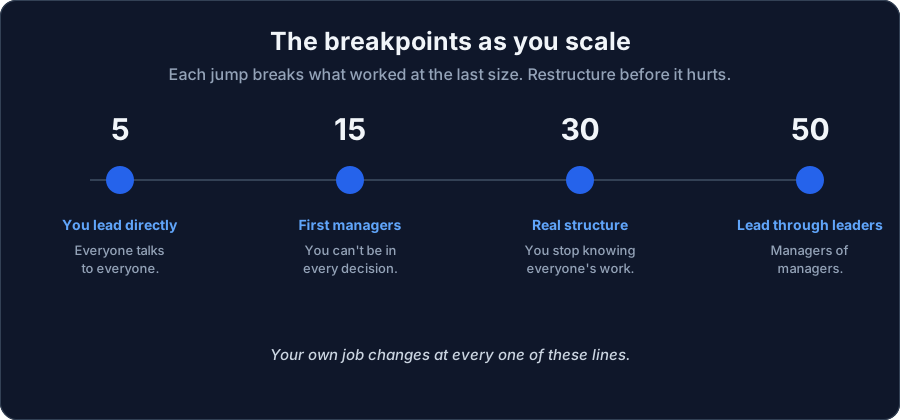
The breakpoints, and what breaks at each
Growth is not smooth. It comes in steps, and at each step something that used to work stops working. The specific headcounts vary by company, but the pattern is remarkably consistent.
| Size | What breaks | What you do about it |
|---|---|---|
| ~5 | Nothing yet — everyone talks to everyone, you're in every decision, and it works. | Enjoy it, and start noticing which parts of your job only you can do. |
| ~15 | You become the bottleneck. Decisions wait on you; context lives only in your head. | Add your first managers or leads. Start delegating decisions, not just tasks. |
| ~30 | You stop knowing what everyone is working on. Coordination between teams gets expensive. | Real structure: clear teams with owners, defined interfaces, and a planning rhythm. |
| ~50 | Your managers are now overloaded the way you were at 15. Single-layer management breaks. | Managers of managers. You now lead through leaders, not through the work. |
The mistake is treating each of these as a crisis to react to rather than a transition to plan for. The org sends signals before it breaks — decisions piling up on your desk, the same coordination problem recurring, a manager quietly drowning. Learn to read those signals as "we've hit the next breakpoint," not "we have a people problem."
Your job is the thing that changes most
Here is the part nobody tells you: at every breakpoint, the job that changes most is yours. At five, you are the best engineer in the room and you lead by doing. By fifty, if you are still trying to be the best engineer in the room, you are failing at the actual job — which is now building the system of people, structure, and decisions that lets other people do great work without you.
This is the hardest transition for technically excellent founders and promoted engineers, because the thing you have to give up — being the person who ships — is the thing that brought you here. (We wrote about this identity shift in the first 90 days as CTO guide; scaling is where it becomes unavoidable.) The tell that you have not made the shift: you are the smartest person on every technical call and the org still feels slow. That means the constraint is no longer technical ability. It is the system around it — and that system is your job now.
Hiring: grow more than you buy
Every scaling org faces the same question at each role: hire externally or promote internally? The default that compounds best is to grow more than you buy.
Internal promotions to lead and manager roles do three things at once: they compound your credibility (people see a real path), they reduce time-to-fill (you already know the person), and they lower the risk of a cultural mismatch that triggers other departures. External hires should be reserved for genuine capability gaps the current team cannot fill — a specialism you lack, or leadership experience at a scale nobody internal has seen.
Two cautions from the pattern:
- Don't promote your best engineer into management by default. A great engineer made into a reluctant manager is a double loss — you lose the engineering and gain a struggling manager. Offer a senior/staff IC track too, and let people choose.
- Hire ahead of the breakpoint, not after. Hiring takes longer than you expect, especially before you have a recruiting brand. If you wait until you're at thirty to start hiring the structure you need at thirty, you'll build it at forty, in pain.
Structure follows communication, not the org chart
As you cross thirty, the real problem becomes coordination. Teams that used to sync in a hallway now need deliberate interfaces. The principle that scales: structure your teams around the things they own, and keep the dependencies between teams as few and as explicit as possible. A team that has to coordinate with four others to ship anything is a team that will ship nothing.
Give each team a clear mission, a clear owner, and as much autonomy to deliver it as you can. Your job shifts from making decisions to setting the context in which good decisions get made without you: the goals, the guardrails, the priorities, and the handful of standards that must hold across every team.
Process: add it late, and only where it pays
Engineers at scaling companies fear process, usually because they've seen it added badly — bureaucracy that slows everything to protect against a problem that happened once. The discipline: add the least process that solves a real, recurring pain, and no more.
A useful test: introduce a process only when the absence of it has bitten you at least twice. Before that, you're solving a problem you don't have yet and paying for it in speed. When you do add process — a planning cadence, a code-review standard, an incident review — frame it in terms of the pain it removes, not the control it adds, and kill it if the pain goes away.
Where to go from here
Scaling is the transition where the CTO job stops being about technology and starts being about organisation design — and it is one of the most consistent moments teams reach for outside help, because the mistakes are expensive and hard to see from the inside. If a sounding board would help, our directory of CTO coaches groups specialists by how they work, including several focused on exactly this stage of scaling.
To see how your current strengths map across the five dimensions of the role, start with the free CTO Readiness Assessment. And the broader first-time CTO guide covers the rest of the transition.
The engineering org you're building is not a bigger version of the one you have. It is a different thing, redesigned at each breakpoint — and the CTOs who scale well are the ones who see the next breakpoint coming and rebuild before it breaks.
Ready to level up?
Discover your strengths and gaps with our free CTO Readiness Assessment.
Take the CTO Readiness Assessment