Your First Tech-Debt Crisis: A First-Time CTO's Playbook
Almost no first-time CTO inherits a clean codebase. You inherit the architecture decisions, the shortcuts taken under deadline pressure, and the quiet trade-offs the previous technical leadership never wrote down. Then, usually within your first quarter, the bill arrives: the board wants velocity, the codebase needs investment, and you are the one who has to reconcile the two in front of people who don't want to hear that it's complicated.
This is not an edge case. In our State of First-Time CTOs 2026 analysis, technical debt was the single most-cited concern — 91% of CTOs called it a major challenge, ranking it above talent, security, and budget. And CAST's research found developers spend roughly a third of their time managing legacy systems rather than building new things. For a first-time CTO, debt isn't a warning sign. It's the baseline — and it's a ceiling on everything your team can deliver before you change anything else.
Here is how to handle your first tech-debt crisis without either torching the roadmap or letting the problem compound until it explodes.
The two ways first-time CTOs get this wrong
Under pressure, the instinct pulls in one of two directions, and both fail.
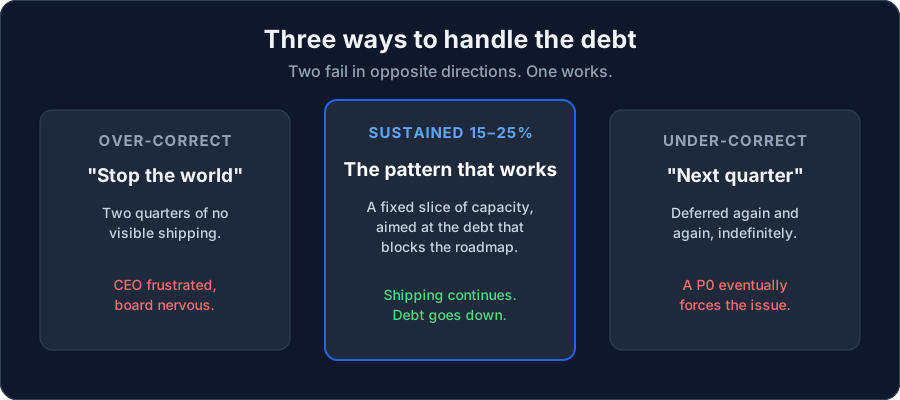
Over-correcting is the "stop the world" cleanup — declaring a debt sprint that visibly halts feature work for two quarters. It feels responsible. It reads, to a CEO and board, like the new CTO is polishing the plumbing while the company waits. The improvements are real but invisible to the people whose confidence you need, and you spend credibility you haven't earned yet.
Under-correcting is the mirror image: deferring debt for "next quarter," every quarter, because there is always something more urgent. This works right up until a P0 incident — an outage, a breach, a migration that can no longer be delayed — forces the conversation at the worst possible moment and in the worst possible framing.
The pattern that works: sustained, targeted allocation
The approach that holds up is neither heroic cleanup nor endless deferral. It is a sustained allocation — typically 15 to 25 percent of engineering capacity — pointed at the specific debt that is currently constraining business priorities.
Two words in that sentence are doing the work. Sustained, because debt paydown is an 18-to-36-month workstream, not a one-time project — a steady fraction of capacity, protected every cycle, beats any sprint. Targeted, because you are not fixing the codebase; you are clearing the debt that blocks the next thing the business is trying to do. That forces you to prioritise the debt that actually matters over the debt that most offends you aesthetically — and those are rarely the same list.
The reframe that makes this survivable with the board is the one we cover in board-ready CTO communication: don't sell "fixing the codebase." Sell "unblocking the next two strategic initiatives," with the initiatives named. Same work, framed as something the board can validate rather than something they have to take on faith.
Keep a scoreboard the business can read
The difference between "the new CTO is rebuilding everything" (board panic) and "the new CTO knocked four weeks off our release cycle last quarter" (board confidence) is often just a visible record. Keep a simple monthly scoreboard: what shipped, what got faster, and which recurring bugs or incidents stopped happening.
This does two jobs. It translates invisible engineering work into business-legible progress, and it disciplines you — if a debt investment can't be tied to something that got faster, cheaper, or safer, it probably wasn't the debt that mattered most.
A first-90-days sequence for the debt
If you have just walked into it, resist the urge to act in week one. A workable order:
- Diagnose before you touch anything. Map where the debt actually costs you — the systems that break, the changes that take too long, the parts everyone is afraid to touch. Talk to the engineers; they know exactly where the bodies are buried.
- Tie the worst of it to a business priority. Find the overlap between "most painful debt" and "thing the company is trying to do next." That overlap is your first target — it's where paydown is easiest to justify.
- Set the allocation and protect it. Commit the 15–25% and defend it against the pressure to spend it on features. An allocation you raid the first busy week isn't an allocation.
- Report it in business terms from day one. Start the scoreboard immediately, so the story of your tenure is "steadily unblocking the roadmap," not "went quiet and rewrote things."
Where to go from here
Handling your first debt crisis well is as much about managing the board and your own instincts as it is about the code. It is a common moment to want an outside perspective from someone who has made these calls before — our directory of CTO coaches lists specialists by how they work, including several with a crisis- and scaling-stage focus.
To map where you stand across the five dimensions of the role, start with the free CTO Readiness Assessment, and see the first-time CTO guide for the rest of the transition.
Tech debt is not a problem you solve once. It is a constraint you manage continuously — and the first-time CTOs who do it well are the ones who stop treating it as an emergency and start treating it as a fixed, protected, business-justified line item.
Ready to level up?
Discover your strengths and gaps with our free CTO Readiness Assessment.
Take the CTO Readiness Assessment