The Loneliest Seat: Beating CTO Isolation and Burnout
There is a specific loneliness that comes with the CTO title, and almost nobody warns you about it. The team you used to belong to now reports to you. The C-suite is small, and no one in it does your job. The board sees your upside and your risk, not your doubts. And the people who would actually understand what you're facing — other first-time CTOs — are scattered across companies you don't have access to. You are, structurally, the only one of you in the building.
Most first-time CTOs say nothing about this, because admitting it feels like admitting weakness. That silence is exactly why it's dangerous. In our State of First-Time CTOs 2026 analysis, isolation and the quiet burnout it produces were among the most consistently under-reported forces on the role — the surveys are only starting to capture what practitioners have known for years. The "always-on" pressure of the job, combined with having no peer inside the company, produces a level of strain most first-timers are unprepared for.
This is about naming that isolation honestly, and building the structure that keeps it from becoming burnout.
Why the role isolates you (it's structural, not personal)
If you feel isolated as a CTO, it is not a character flaw and it is not because you're doing it wrong. It's built into the shape of the job:
- You're the only one. One CTO per company. There is no peer at your level doing the same work, the way two engineers or two salespeople can compare notes.
- Your old peer group now reports to you. The engineers you used to vent to are your reports. The relationship changed the day you got the title, and you can't un-change it.
- The pressure points in two directions. The board pushes on the upside; the team pushes on the downside; and you absorb the tension between them alone.
- The comparison trap. Fractional CTOs operating at three to five companies produce visible output — frameworks, decks, hires — that can make a first-timer feel impossibly slow, on a benchmark that was never fair.
Seeing these as structural matters, because the fix is structural too. You don't beat isolation by trying harder or caring less. You beat it by deliberately building the support the role fails to provide.
Build the support before you need it
The support has to come from outside the company, because inside it, you're alone in the role. The mistake is waiting until you're already burning out to go looking — the time to build this is before the crisis, when you have the bandwidth to choose well.
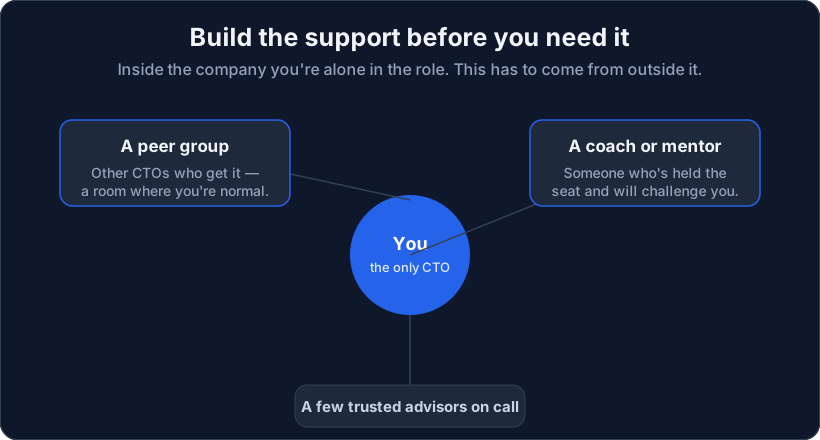
A peer group of other CTOs. The single highest-leverage thing you can do. A room — a community, a mastermind, a small trusted group — where your problems are normal and someone else has already solved the thing you're stuck on. It reduces the isolation directly, because the core of the isolation is "no one else understands this," and a peer group is a standing counterexample.
A coach or mentor who has held the seat. Someone outside your company and outside your reporting line, whose only job is your judgement and your effectiveness — and who will challenge you honestly rather than reassure you. This is the confidential space to think out loud about the things you can't say to the CEO, the board, or the team.
A few trusted advisors on call. You don't need a large network. Two or three people you can text when a board moment or a hard people-decision lands — people who know you and will give you a straight answer fast.
Watch for the burnout signals — in yourself
Isolation becomes burnout quietly. The tells are worth knowing before they compound: dreading the work you used to enjoy, a shrinking ability to make decisions, cynicism creeping into how you talk about the team, working longer hours to feel less in control, and the loss of the keyboard — the grief technical leaders feel at no longer being the person who ships — curdling into a sense that the job isn't yours.
None of these means you're failing. They mean the load has outrun the support, and the support is a thing you can build. The first-time CTOs who last are not the ones who need less. They're the ones who resourced themselves early — before the seat got as heavy as it was always going to get.
Where to go from here
If the isolation is the part of the role hitting hardest right now, an outside sounding board is the most direct fix — and it's the thing a peer community or a coach is built to provide. Our directory of CTO coaches groups specialists by how they work, and several lead with exactly this: community, peer groups, and confidential support for the loneliness of the seat.
To take stock of where you stand — self-management, including how you handle stress and delegation, is one of the five dimensions — start with the free CTO Readiness Assessment. And the first-time CTO guide covers the wider transition.
The loneliest part of the CTO job is believing you're the only one who finds it lonely. You're not — it's the most common unspoken experience in the role. Build the support that the org structure leaves out, and build it before you need it.
Ready to level up?
Discover your strengths and gaps with our free CTO Readiness Assessment.
Take the CTO Readiness Assessment