State of CTO Coaching 2026: Does It Work, What It Costs, and How to Buy It Well
Ask three simple questions about CTO coaching — does it work, what does it cost, and how do you buy it well — and the market gives you three non-answers. The efficacy numbers people quote are for coaching in general, not for CTOs. The market-size figures are for the whole coaching profession, or the whole executive-coaching-and-leadership-development industry, neither of which is CTO coaching. And the prices are mostly hidden behind "book a call." We went looking for a straight answer, could not find one, and so assembled the evidence ourselves.
This is the first structured, sourced map of CTO coaching as a category: what it is, whether the evidence says coaching works, what the real price bands are, the five ways it is actually delivered, and how to tell coaching apart from consulting and fractional leadership before you buy. Every number here is sourced inline. Where a credible number does not exist, we say so rather than invent one — because the honest state of this category is that it is young, fragmented, and under-measured, and pretending otherwise would not help the first-time CTO trying to decide whether to spend real money on it.
It is a companion to our State of First-Time CTOs 2026 report. That one answers what is the job actually like? This one answers the adjacent question the market keeps fumbling: is the help worth buying, and how do you buy it well?
Key Findings
- The wider coaching profession is real and growing fast. It generated an estimated $5.34 billion in revenue in the year to 2025 — up about 17% from the $4.564 billion ICF's prior study recorded for 2022 — across 122,974 practitioners, up 15% since 2023 (ICF 2025 Global Coaching Study, PwC, 10,000+ respondents across 127 countries). Leadership and executive work is the majority of it: 36% plus 18%, or 54% combined.
- There is no credible "CTO coaching" market size, and you should distrust anyone who quotes one. The two numbers usually offered — the $5.34B coaching profession and the roughly $104-billion executive-coaching-and-leadership-development market — are both far broader than CTO coaching. The one input a real estimate would need, the rate at which engineering leaders actually buy coaching, has never been measured.
- The evidence that coaching works is solid — for coaching as a category, not for CTO coaching specifically. A 2023 meta-analysis of randomised controlled trials found an overall effect of Hedges' g = 0.43, and a much stronger effect on behaviour (g = 0.73) than on attitudes (g = 0.34) (Frontiers in Psychology, 2023). No one has run that study on CTO coaching as a distinct modality.
- Prices span two orders of magnitude, because "CTO coaching" is really three different products. Marketplace and advisory mentorship starts around $300 a month; specialist coaching retainers run roughly $2,500–$5,000 a month; coaching that shades into fractional or interim leadership runs $10,000–$20,000 a month. If you compare on price alone, you are comparing different things.
- Demand is problem-led, supply is founder-led. Buyers do not search for "CTO coaching"; they search for the six specific problems it solves — the role transition, scaling the team, board communication, a tech-debt crisis, isolation, and part-time leadership. Supply is a fragmented set of ex-CTOs and small communities, not an established industry with standard offers.
Two markets hiding under one word
The first thing to clear up is the sizing, because almost every claim about "the CTO coaching market" is built on a category error.
There are two real, well-measured numbers in this space, and neither one is CTO coaching.
The first is the coaching profession as a whole. The ICF 2025 Global Coaching Study — conducted by PwC across more than 10,000 practitioners in 127 countries — puts its annual revenue at $5.34 billion, up about 17% from the $4.564 billion the prior ICF study recorded for 2022, spread across 122,974 coaches worldwide. Leadership and executive coaching is the largest slice, 54% of coaches' primary focus. That is the pool CTO coaches are drawn from, but it includes every life coach, career coach, and wellness coach on earth.
The second is the executive-coaching-and-leadership-development market, which Mordor Intelligence sizes at roughly $104 billion in 2025, growing at roughly 9% a year. That number is a genuine tailwind — organisations are spending more on developing leaders every year — but it bundles all executive coaching with all corporate leadership-development spend. A day of generic management training in a Fortune 500 counts toward it. CTO coaching is a rounding error inside it.
So what is the CTO coaching market worth? The honest answer is that nobody knows, and a credible estimate cannot yet be built. You would need three inputs: the number of companies with an engineering leader senior enough to buy coaching, the share of those leaders who actually engage a coach in a given year, and the average spend. The first is estimable. The third we can bound from pricing (below). The middle one — the attach rate — has never been measured for engineering leaders specifically, and it is the input the whole estimate swings on. Any "CTO coaching TAM" you see quoted has silently guessed that number, which is why we will not quote one. The category is real and clearly growing on the back of the two markets above; its precise size is simply not yet knowable.
| What it measures | 2025 size | Why it is not the CTO-coaching market |
|---|---|---|
| The whole coaching profession (ICF/PwC) | $5.34B revenue, 122,974 coaches | Includes all life, career, health and wellness coaching worldwide. |
| Executive coaching + leadership development (Mordor) | ~$104B in 2025, ~9%/yr growth | Bundles all exec coaching with all corporate L&D spend. |
| CTO coaching specifically | Not credibly measurable yet | The buy-rate among engineering leaders has never been measured. |
Does coaching actually work?
This is the question that decides whether the rest matters, and here the evidence is genuinely encouraging — with one caveat you have to hold onto.
The strongest evidence comes from randomised controlled trials, the same design used to test medicine. A 2023 meta-analysis in Frontiers in Psychology pooled RCTs of executive coaching and found an overall effect of Hedges' g = 0.43 (95% CI 0.35–0.50, p < 0.001) — a solid, moderate effect for a workplace intervention. Coaching, on average, measurably beats no coaching.
The more useful finding is where the effect lands. When the researchers split outcomes by type, coaching moved behaviour most and attitudes least:
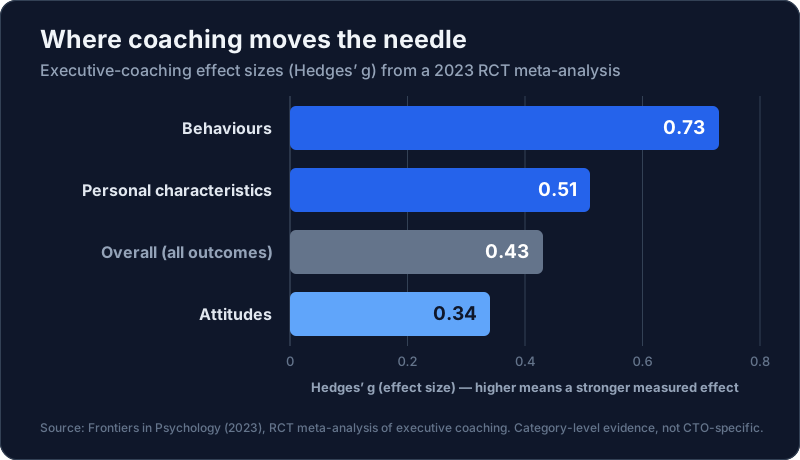
Behavioural outcomes — what a leader actually does differently — showed the largest effect at g = 0.73. Personal characteristics such as resilience and self-efficacy came next at 0.51. Attitudes moved least, at 0.34. In plain terms: coaching is good at changing behaviour and judgement, less potent at shifting how someone feels. That maps well onto what a first-time CTO needs — a different way of running a board meeting, a clearer decision on build-versus-buy, a better weekly rhythm — and less well onto anything a coach cannot change, like whether the company is fundamentally viable.
Here is the caveat, and it is load-bearing: this evidence is for coaching as a category, not for CTO coaching as a distinct thing. The RCTs studied executive and workplace coaching broadly. No one has run a controlled trial on CTO-specific coaching, and given how young and fragmented the niche is, no one is likely to soon. So the honest claim is not "CTO coaching is proven to work." It is "coaching is a well-evidenced intervention, and there is no reason a CTO-specific version would be an exception — but the specific proof does not exist, and anyone selling you certainty is overselling." The mechanism the trials reward — regular, structured, goal-directed sessions with an outside expert — is exactly the mechanism the better CTO coaches use. That is the reasonable basis for optimism, not a study with "CTO" in the title.
The five ways CTO coaching is actually delivered
"CTO coaching" is not one product. Across the market it takes five recognisable shapes, and the shape matters more than the label — it determines what you get, how much you pay, and what you are giving up. These are the same five archetypes we use to organise our directory of CTO coaches, where each is mapped to named providers.
| Archetype | How it works | Best when |
|---|---|---|
| Solo ex-CTO coach | 1:1 coaching from a single named operator who has held the seat. | You want lived-experience credibility and a personal relationship, and can work around one person's availability. |
| Community + coaching | 1:1 coaching wrapped in peer groups, a members' Slack, masterminds and events. | Isolation is part of the problem and you value the ongoing peer network as much as the coaching. |
| Coaching + fractional / interim | Advice plus hands-on operating support — coaching that can shade into doing. | You are in transition or crisis and need someone who can both guide you and step in. |
| Boutique advisory firm | Practitioner-led coaching, workshops and crisis support from a small team. | You want team breadth and a B2B-friendly engagement rather than one person's brand. |
| Marketplace | Matchmaking with transparent profiles, prices and trial access. | You want to browse, compare and start quickly, and are comfortable vetting quality yourself. |
The two ends of that table are almost different industries. A marketplace mentor and a boutique advisory retainer both call themselves "CTO coaching," but one is a transparent, trialable, low-commitment relationship you manage yourself, and the other is a structured six-month engagement with a firm. Knowing which shape you are buying is the single most important thing to get right, and it is the thing buyers most often get wrong.
What it costs
Pricing in this category looks chaotic until you segment it by depth of intervention. Once you do, three clean bands appear — and they span two orders of magnitude, which is the tell that "CTO coaching" is really three different products under one name.
| Tier | Typical price | What you are buying |
|---|---|---|
| Marketplace / advisory mentorship | From ~$300 / month | Lighter-touch access to a senior mentor; you drive the agenda. Prices are public and you can start quickly. (MentorCruise) |
| Specialist coaching retainer | ~$2,500–$5,000 / month | Structured 1:1 coaching with an ex-CTO; often bundled with peer groups. Senior pairings run up to $10,000. (7CTOs) |
| Coaching + fractional / interim | $10,000–$20,000 / month | Coaching plus hands-on operating support — someone who advises and can step in during a transition or crisis. (MentorCruise) |
Two things are worth saying plainly about these numbers. First, most specialist coaching clients sit in the $2,500–$5,000 band — 7CTOs states its range as $2,500 to $10,000 a month, with most clients paired in the lower half. That is the realistic price of a serious coaching relationship, not the headline top of the range. Second, the jump to $10,000–$20,000 is not a jump in coaching quality — it is a change in product. At that level you are paying for execution capacity, the fractional or interim leader who does the work, not just the coach who helps you do it better. If you are comparing a $400 marketplace mentor against a $15,000 fractional engagement on price, you are comparing a bicycle against a van.
Many of the best specialist providers do not publish pricing at all, quoting instead after a call — which is normal for the boutique end of the market but makes exactly this kind of comparison harder. Where a provider is silent, our directory says "Not public" rather than guess.
The six jobs buyers actually hire coaching to do
Almost nobody wakes up wanting "a CTO coach." They hit a specific problem and go looking for help with that. Across CTO communities and search behaviour, six jobs recur — and they line up closely with the pressures our State of First-Time CTOs 2026 report documents.
- The role transition. The step from senior engineer or VP Engineering into the CTO seat is a change of job, not a promotion, and the first ninety days set the tenure. This is the most common reason first-timers seek a coach — someone who has made the leap. (See our first-90-days playbook.)
- Scaling the org. The team that worked at five breaks at fifteen and again at fifty. Coaching here is about org design and letting go of the keyboard. (See scaling an engineering org from 5 to 50.)
- Board and stakeholder communication. The most consistent gap among engineer-promoted CTOs is commercial vocabulary — translating engineering into the language of risk, money and confidence. (See board-ready CTO communication.)
- A tech-debt crisis. With 91% of CTOs naming technical debt as their biggest challenge (STX Next), the inherited-codebase-versus-roadmap fight is near-universal, and it is a common trigger for outside help. (See your first tech-debt crisis.)
- Isolation and burnout. One CTO per company, no internal peer, pressure from above and below. The structural loneliness of the role is what community-shaped coaching exists to solve. (See beating CTO isolation and burnout.)
- Part-time or interim leadership. With fractional executive demand up 68% year on year (Cerius Executives, 2024), a growing share of buyers want leadership and coaching in one engagement. (See fractional versus full-time CTO.)
Reading the market this way — by the problem, not the product — is also how you avoid overbuying. A board-communication problem does not need a $15,000 fractional engagement; it needs a specialist coach and a few months. Matching the job to the archetype is most of the buying decision.
How to choose — and how to tell coaching from consulting from fractional
Once you know which job you are hiring for, the choice comes down to seven questions. These are the criteria we apply in the directory, and they hold across all five archetypes.
- Real operating credibility. CTOs are rightly sceptical of generic leadership advice. You want someone who has actually held the seat, not read about it.
- Stage relevance. Seed and Series A problems are not post-Series C problems. Match the coach to your stage.
- Confidentiality and trust. The hardest issues cannot be discussed internally. The coach is your outside-the-building space; that only works if the trust is real.
- Structured goals and diagnosis. This is what separates a coaching relationship from a series of nice conversations. Ask how progress is defined before you sign.
- Between-session support. In a board week or a crisis, the calendar will not wait for the next scheduled hour. Ask what access looks like.
- A community or peer layer. Where isolation is part of the problem, a network you keep beyond the engagement is worth as much as the 1:1 time.
- A clear coaching-versus-consulting-versus-fractional boundary. This is the trap. The three solve different problems, and the words are used loosely across the market.
That last point deserves its own line, because category ambiguity is the most expensive mistake in this market. A coach helps you get better at the job. A consultant delivers an answer or an artefact — an architecture review, a hiring plan. A fractional CTO does the job part-time. They overlap, providers blur the lines, and the same monthly fee can buy any of the three. Buy a coach expecting a consultant and you will feel underserved; buy a fractional expecting a coach and you will not build your own capability. Our full comparison of CTO coaching versus executive coaching works through where each format fits, and where the generic-executive-coach option falls short for a technical leader.
Market maturity verdict
Put it all together and the state of CTO coaching in 2026 is clear enough to name: it is a real, growing, still-early category, past zero-to-one but well short of mature.
The signs of a real category are all present. The underlying coaching profession is large and growing double-digits. Demand is genuine and problem-led. A recognisable set of specialist providers has emerged across five delivery models. And the evidence base for coaching as an intervention is solid.
The signs of immaturity are equally present. There is no agreed market size, and the one that would matter cannot yet be measured. Pricing is mostly hidden, and where it is visible it spans two orders of magnitude because the offers underneath are not the same product. The providers are heterogeneous and mostly founder-led rather than institutional. And there is no CTO-specific efficacy evidence, only the strong category-level proof it inherits. Insiders describe the niche as new because it is.
For the first-time CTO deciding whether to spend on this, the takeaway is neither hype nor cynicism. Coaching is a well-evidenced way to get measurably better at a job — most of all at the behavioural parts, which is most of what the CTO role actually is. CTO-specific coaching is a young, honest application of that. It is worth buying if you match the job to the right archetype, know which of the three products you are actually purchasing, and hold your provider to the seven criteria above. Buy it that way and the odds are with you. Buy it on a vague promise and a hidden price, and you are the one running the experiment.
Methodology
This report synthesises three primary sources — the ICF 2025 Global Coaching Study (PwC, 10,000+ respondents / 127 countries), Mordor Intelligence's executive-coaching market analysis, and a 2023 Frontiers in Psychology meta-analysis of randomised controlled trials of executive coaching — with provider pricing taken from public pages (7CTOs, MentorCruise), verified on 12 July 2026. The five archetypes, six buyer jobs and seven selection criteria are drawn from our own market research and are the same framework behind the CTO coach directory. Supporting figures on tech debt, fractional demand, AI trust and talent are carried from our State of First-Time CTOs 2026 report.
Two limits are stated deliberately rather than smoothed over. First, no standalone market size for CTO coaching is offered, because the buy-rate among engineering leaders — the input any credible estimate turns on — has not been measured. Second, the efficacy evidence is for coaching as a category; there is no controlled trial of CTO-specific coaching, and none is claimed. Prices drift; we re-confirm them on each refresh. Corrections, additional sources and methodology questions: research@ctocoach.com.
Sources
- International Coaching Federation, 2025 Global Coaching Study (PwC) — profession revenue $5.34B, 122,974 coaches, 54% leadership/executive focus
- Mordor Intelligence, Executive Coaching Market — executive coaching + leadership-development market size and growth
- Nicolau, A., Candel, O. S., Constantin, T., and Kleingeld, A., The effects of executive coaching on behaviors, attitudes, and personal characteristics: a meta-analysis of randomized control trial studies, Frontiers in Psychology, 2023 — overall g = 0.43; behaviours 0.73; personal characteristics 0.51; attitudes 0.34
- 7CTOs — Executive Coaching — stated coaching range $2,500–$10,000 / month, most clients $2,500–$5,000
- MentorCruise — Fractional CTO — marketplace and fractional pricing signals
- STX Next Global CTO Survey / Intelligent CIO — 91% of CTOs cite technical debt as their biggest challenge
- Cerius Executives, 2024 fractional-leadership report — 68% year-over-year growth in fractional executive demand
Related from CTOCoach
- The CTO Coach Directory — the named providers behind the five archetypes in this report, grouped by how they work, with pricing signals and who each is best for. No referral fees.
- Take the free CTO Readiness Assessment — map your own gaps across five dimensions before you decide what kind of help to buy.
- State of First-Time CTOs 2026 — the companion report on what the first-time CTO role actually demands, and the pressures the coaching above exists to relieve.
About CTOCoach
CTOCoach.com publishes research and tools for first-time and aspiring CTOs. This report is updated as the category and its pricing evolve; methodology and corrections are tracked openly at research@ctocoach.com. It is free to read and free to cite with attribution to CTOCoach · State of CTO Coaching 2026.
Ready to level up?
Discover your strengths and gaps with our free CTO Readiness Assessment.
Take the CTO Readiness Assessment